Federal consumer protection rules give you the right to revoke a company's permission to take automatic payments from your bank account. This guide walks Colorado borrowers through how to stop automatic debits, use stop payment orders, and dispute unauthorized withdrawals.
Who Can Help You Understand Structured Settlement Options?
If you are asking what organizations can help you understand your options regarding structured settlement payments, you are probably weighing a company’s offer to swap your future payments for cash now. This guide walks through the independent resources the Consumer Financial Protection Bureau (CFPB) points to, what each one does, and the questions to get answered in writing before you sign anything.
It is written for anyone receiving structured settlement payments from a personal injury or disability-related settlement, including Colorado Springs residents and military families who get “cash now” flyers in the mail.
What organizations can help me understand my options regarding structured settlement payments?
The Consumer Financial Protection Bureau lists several independent sources of help for people considering giving up structured settlement payments:
- The Consumer Financial Protection Bureau itself, through its published consumer guidance
- The lawyer who represented you in the structured settlement or disability matter
- Legal aid offices and volunteer attorney programs
- Lawyer resources listed by the American Bar Association
- Nonprofit credit counselors, reached through the Financial Counseling Association of America or the National Foundation for Credit Counseling
- Your state Attorney General’s Office or state consumer protection office
- A tax advisor, for questions about tax implications of a lump sum
- The department that administers any public benefits you receive

Each of these plays a different role, so the next sections explain what a structured settlement is and then walk through the organizations one at a time.
What is a structured settlement?
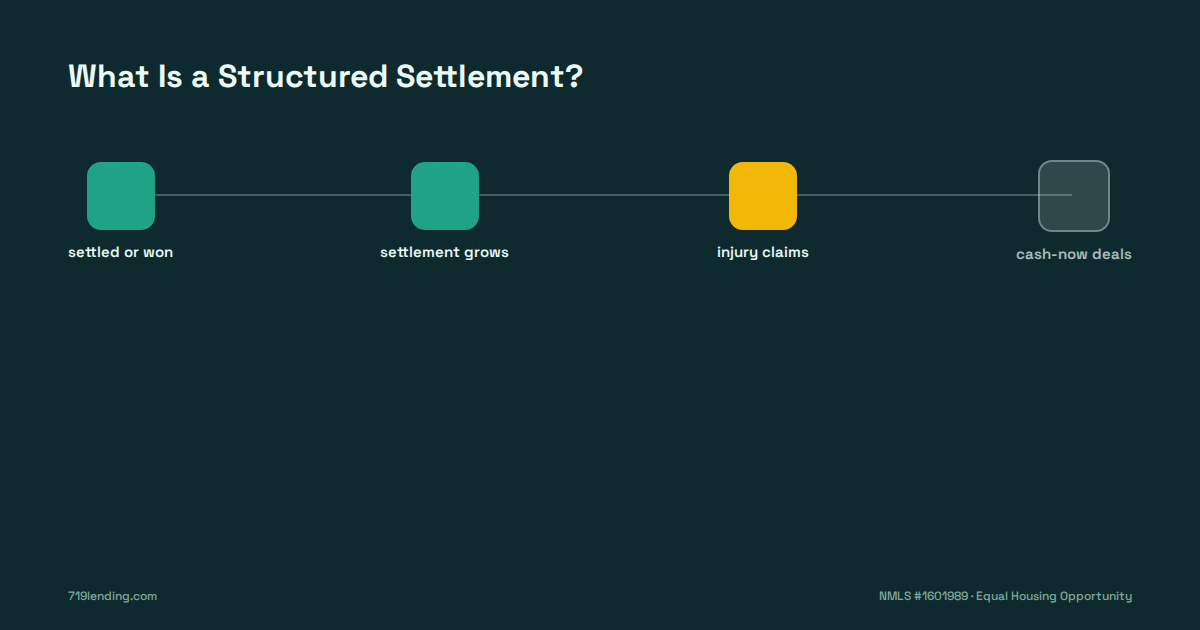
A structured settlement is the way many personal injury claims pay out when you settle or win your case. Instead of one payment, you receive regular payments for a specified length of time.
Under a structured settlement, the payment schedule can be monthly, quarterly, semi-annually, annually, or a set number of lump-sum payments. A traditional settlement, by contrast, is generally paid out in a single payment.
Why the payment schedule matters
Structured settlement payments protect you from spending the entire settlement at once and provide income over a period of time. The CFPB notes that these regular payments can contribute to long-term financial stability and a steady flow of income.
The CFPB also notes that monthly structured settlement payments may be tax-free, while receiving a lump sum payment may have tax implications — a point to confirm with a tax advisor before signing anything.
Structured settlements are not SSDI or SSI
These settlement payments are sometimes called disability payments because they compensate you for injuries. They are not government-provided Social Security Disability Insurance (SSDI) or Supplemental Security Income (SSI) payments, which follow entirely different rules.
Understanding what you have is step one. Step two is understanding who wants it.
Why companies want your structured settlement payments
Some companies aggressively market “cash now” deals to people with structured settlement payments. They make money by acquiring your structured settlement for much less than the total settlement is worth over time.
These companies may want the entire structured settlement or only a portion of it. Some specifically target people with disabilities who have structured settlements.
What happens if you accept a lump sum
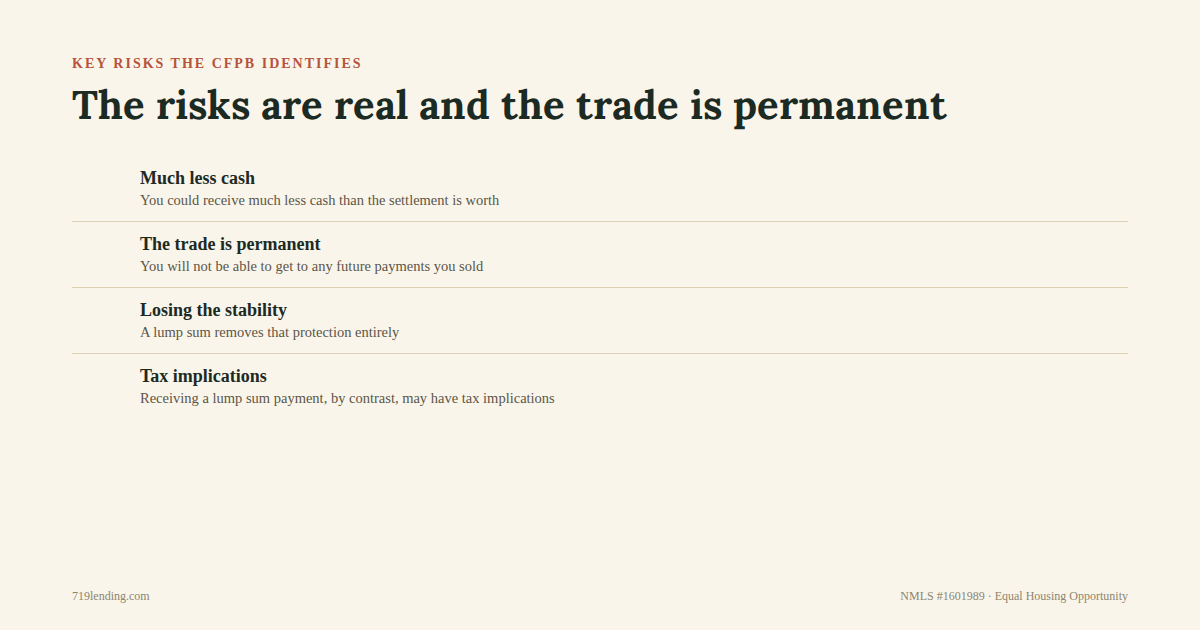
Usually you get one lump sum payment upfront and permanently give up the right to receive your future payments. Those future payments go to the company that took over the structured settlement, and you cannot get to them later.
While a large amount of money at once may feel helpful, the CFPB cautions that in the long run you will get a lot less money than the settlement would have paid out. Regular payments may give you more stability to manage your finances, pay rent or a mortgage, and keep up with bills.
That is exactly why independent advice matters — starting with the federal agency that published this guidance.
The Consumer Financial Protection Bureau
The Consumer Financial Protection Bureau is a federal agency that implements and enforces federal consumer financial law and works to keep consumer financial markets transparent, fair, and competitive.
The CFPB publishes plain-language guidance on what to know before giving up monthly disability, personal injury, or structured settlement payments in exchange for a lump sum. You can read it directly at consumerfinance.gov in the Ask CFPB section.
That guidance is the primary official source for this topic, and it points readers toward the people and organizations covered below.
Your own lawyer and the American Bar Association
The CFPB’s first suggestion for more help is the lawyer who represented you in the disability or structured settlement matter. That attorney already knows the terms of the structured settlement agreement and may be able to advise you on the offer in front of you.
If you no longer have contact with that lawyer, the American Bar Association maintains a list of lawyer resources that the CFPB links to for people in this situation.
Why independent legal advice matters
The CFPB specifically warns against relying on recommendations from the company trying to acquire your structured settlement. Get a second opinion or an independent evaluation from a trusted source — your own attorney or a financial adviser.
If hiring a private attorney is out of reach, there are free and low-cost options next.
Legal aid offices and volunteer attorney programs
Legal aid offices and volunteer attorney programs provide legal help to people who cannot afford a private lawyer, and the CFPB lists them as a resource for structured settlement questions.
Legal aid can be especially useful if you receive public benefits, because the same office can often help you understand whether a lump sum payment would affect eligibility for those benefits.
Legal help covers the contract side. For the budgeting side, there are nonprofit counselors.
Nonprofit credit counselors
A nonprofit credit counselor may be able to help you weigh your options before you trade future payments for instant cash. The CFPB names two organizations as starting points:
- Financial Counseling Association of America (FCAA) — reachable through its website or by phone
- National Foundation for Credit Counseling (NFCC) — reachable through its website or by phone
When a credit counselor helps most
If you are considering a lump sum because you are struggling with bills, a counselor can help you look at alternatives first. The CFPB suggests contacting your creditors to see if you can work something out before giving up settlement payments.
For hospital debt specifically, the CFPB notes you should know your rights on medical bills and check whether the hospital has a charity care program or another way of providing free or reduced prices. Learning how to negotiate with a debt collector is another option the CFPB highlights.
Counselors handle the budget. State officials handle the company making the offer.
State Attorney General and consumer protection offices
Your state Attorney General’s Office or state consumer protection office can tell you whether there are complaints about the company and whether it is licensed to do business in your state. For Colorado residents, that means checking with the Colorado Attorney General’s consumer protection resources.
The court’s role in Colorado and elsewhere
Nearly all states require a judge to approve an agreement to give up a structured settlement. The judge may be required to decide whether the agreement is in your best interest, or is necessary, reasonable, or appropriate.
State law may also provide for certain disclosures before you sign, and depending on your state, you may have the right to cancel or rescind the agreement within a certain time frame even after signing. Get the cancellation rights in writing before you consider signing.
Two more specialists round out the list: tax and benefits advisers.
Tax advisors and public benefits agencies
Because structured settlement payments may be tax-free while a lump sum payment may have tax implications, the CFPB says to consult a tax advisor before signing. Tax treatment varies by situation, so this is a question for a tax professional, not a settlement-purchasing company.
If you receive public benefits now or plan to in the future, a lump sum may impact eligibility. Check with your lawyer, your local legal aid office, or the department that administers those benefits before you act.
Here is the full list of resources in one place.
Quick reference: who helps with what
| Organization | How it helps with structured settlement payments |
|---|---|
| Consumer Financial Protection Bureau | Publishes official consumer guidance on lump sum offers |
| Your original attorney | Knows the settlement terms; can advise on the offer |
| American Bar Association | Lists lawyer resources if you need new counsel |
| Legal aid / volunteer attorney programs | Free or low-cost legal help, including benefits questions |
| FCAA and NFCC credit counselors | Nonprofit help weighing options and alternatives to a lump sum |
| State Attorney General / consumer protection office | Company complaints and licensing checks |
| Tax advisor | Tax implications of a lump sum payment |
| Public benefits agency | Whether a lump sum affects benefit eligibility |
Before any of these conversations, gather the paperwork the CFPB says you are entitled to.
Get the costs in writing first
The CFPB says to get a written statement from the company that wants your structured settlement, covering:
- The total dollar amount of all remaining payments
- The value in today’s dollars of that total
- The number of payments remaining
- How much you would receive as a lump sum
- All fees, interest or discount rate, and costs
Bring that written statement to your attorney, legal aid office, or credit counselor so they can evaluate the actual offer rather than a sales pitch.
Who this applies to in Colorado Springs
Colorado Springs is a heavily military community, and households here deal with injuries, disability settlements, and the financial pressure that can come with a PCS move or a gap in income. Anyone receiving structured settlement payments who gets a flyer or solicitation promising fast cash should treat it carefully.
The CFPB’s advice applies regardless of why you received the settlement: consider all options, talk to people you trust with your finances, and reach out to a lawyer or financial counselor before trading future payments for instant cash.
What to do next
Start with the free, official resource: read the CFPB’s structured settlement guidance at consumerfinance.gov. Then contact the lawyer who handled your case, or a legal aid office if cost is a barrier.
If debt is the pressure driving the decision, call a nonprofit credit counselor through the FCAA or NFCC before you sign anything, and check the company out with the Colorado Attorney General’s consumer protection office. Get every cost, every disclosure, and every cancellation right in writing — and let an independent professional read it before you do.
Frequently asked questions
Who should I talk to before selling my structured settlement payments?
The CFPB recommends your own attorney or an independent financial adviser, a legal aid office or volunteer attorney program, and a nonprofit credit counselor through the Financial Counseling Association of America or the National Foundation for Credit Counseling. Be cautious of advice from the company trying to acquire the settlement.
Does a judge have to approve giving up a structured settlement?
Nearly all states require a judge to approve the agreement. The judge may be required to decide whether the deal is in your best interest, or is necessary, reasonable, or appropriate, and state law may require certain disclosures before you sign.
Are structured settlement payments tax-free?
The CFPB notes that monthly structured settlement payments may be tax-free, while a lump sum payment may have tax implications. Tax treatment varies by situation, so consult a tax advisor before signing anything.
Will taking a lump sum affect my public benefits?
It might. If you receive public benefits now or plan to in the future, a lump sum payment may impact eligibility. Check with your lawyer, your local legal aid office, or the department that administers those benefits first.
How do I check out a company offering cash for my settlement?
Contact your state Attorney General’s Office or state consumer protection office to see whether there are complaints about the company and whether it is licensed to do business in your state. Also get a written statement of all remaining payments, the lump sum offered, and all fees and costs.
Can I cancel after signing a structured settlement buyout agreement?
Depending on your state law, you may have the right to cancel or rescind the agreement within a certain time frame even after signing. The CFPB says to get your cancellation rights in writing before you consider signing.
719 Lending Inc., NMLS #1601989 · Equal Housing Opportunity
719 Lending Inc. is not affiliated with or endorsed by HUD, FHA, VA, USDA, CHFA, the CFPB, or any government agency.
Last updated: October 2026

Related Posts