Federal consumer protection rules give you the right to revoke a company's permission to take automatic payments from your bank account. This guide walks Colorado borrowers through how to stop automatic debits, use stop payment orders, and dispute unauthorized withdrawals.
What Is a Structured Settlement? A Plain-English Guide
What is a structured settlement? In the simplest terms, a structured settlement is an arrangement that pays out the money from a personal injury claim as a stream of regular periodic payments over a set period of time, instead of handing the injured party one lump sum payment up front.
This guide explains how structured settlements work, how they differ from a traditional lump sum settlement, why companies aggressively market cash-now offers for structured settlement payments, and what the Consumer Financial Protection Bureau says you should know before trading future payments for instant cash.
It is written for Colorado readers, including the many service members and veterans around Colorado Springs who receive these solicitations and want a straight answer before they respond.
What is a structured settlement?
If you made a personal injury claim and settled or won your case, you are likely receiving the money through either a traditional settlement or a structured settlement.
A traditional settlement is generally paid out in one payment. A structured settlement, by contrast, delivers regular tax-free payments for a specified length of time.
The structure protects you from spending the entire settlement at once. Instead, you receive income over a period of time, which can contribute to long-term financial stability and a steady flow of money for rent, a mortgage, and everyday bills.
Key takeaways: structured settlements turn one pile of settlement money into a dependable payment stream, the payments may be tax-free, and giving up those future payments for a lump sum almost always means receiving less than the settlement is worth over time.
With the definition settled, the next question is how the payment mechanics actually work.
How do structured settlements work?
A structured settlement grows out of the settlement agreement that resolved the personal injury case. Instead of one check, the agreement calls for scheduled payments delivered over time.
Payment schedules you might see
Structured settlement payments can arrive monthly, quarterly, semi-annually, or annually. The settlement agreement can also provide a set number of lump-sum payments spaced out over the years.
The schedule is fixed when the case resolves. That predictability is the whole point: the injured party knows what is coming and when, which makes budgeting around medical care and lost income far more manageable.
What structured settlement payments are not
People sometimes call these disability payments because the money compensates for injuries. But structured settlement payments are not government-provided Social Security Disability Insurance (SSDI) or Supplemental Security Income (SSI) payments.
Keeping that distinction clear matters, because the rules for selling or changing each type of payment are completely different. Next, it helps to see the structured settlement side by side with a lump sum settlement.
Structured settlement vs. lump sum settlement

Both arrangements resolve the same personal injury claim. The difference is entirely in how the settlement money reaches you.
| Feature | Structured settlement | Traditional lump sum settlement |
|---|---|---|
| How you are paid | Regular periodic payments over a specified length of time | Generally one payment |
| Spending risk | Protects you from spending the entire settlement at once | The full amount is available, and spendable, immediately |
| Income stability | Steady flow of income for bills, rent, or a mortgage | No ongoing payment stream; you manage the money yourself |
| Tax treatment | Payments may be tax-free; confirm with a tax advisor | Tax treatment varies; confirm with a tax advisor |
| Flexibility | Schedule is set in the settlement agreement | Full control, and full responsibility, from day one |
Neither structure is automatically right for everyone, which is why the people most often holding structured settlements are worth a closer look.
Who typically has a structured settlement?
Structured settlements come from personal injury claims that were settled or won. If a lawsuit over an injury ended with an agreement to pay you over time, you are a structured settlement recipient.
The CFPB notes that some companies specifically target people with disabilities who have structured settlements, which is one reason the agency urges caution with any cash-now solicitation.
A note for the Colorado Springs military community
Colorado Springs is a heavily military market, and households here deal with PCS moves, deployments, and income changes that can make a sudden lump sum payment look tempting.
If a flyer promising fast cash for your periodic payments lands in your mailbox, treat it the same way the CFPB advises everyone to: slow down, talk to people you trust with your finances, and get independent advice before signing anything.
That caution exists because an entire industry is built around buying these payment streams, and it is worth understanding how those buyers make money.
Why do companies want your structured settlement payments?
Some companies aggressively market cash-now deals to people with structured settlements. Their business model is straightforward: they make money by acquiring your structured settlement for much less than the total settlement is worth over time.
These settlement purchasers may want you to give up the entire structured settlement or just a portion of it. Either way, the gap between what your future payments are worth and what they hand you as a lump sum payout is their profit.
If you receive a flyer or solicitation promising fast cash or a lump sum payment for your monthly or periodic payments, the CFPB’s advice is blunt: be careful.
Understanding the sales pitch is half the battle. The other half is understanding exactly what you give up when you accept it.
What happens if you sell your structured settlement payments?
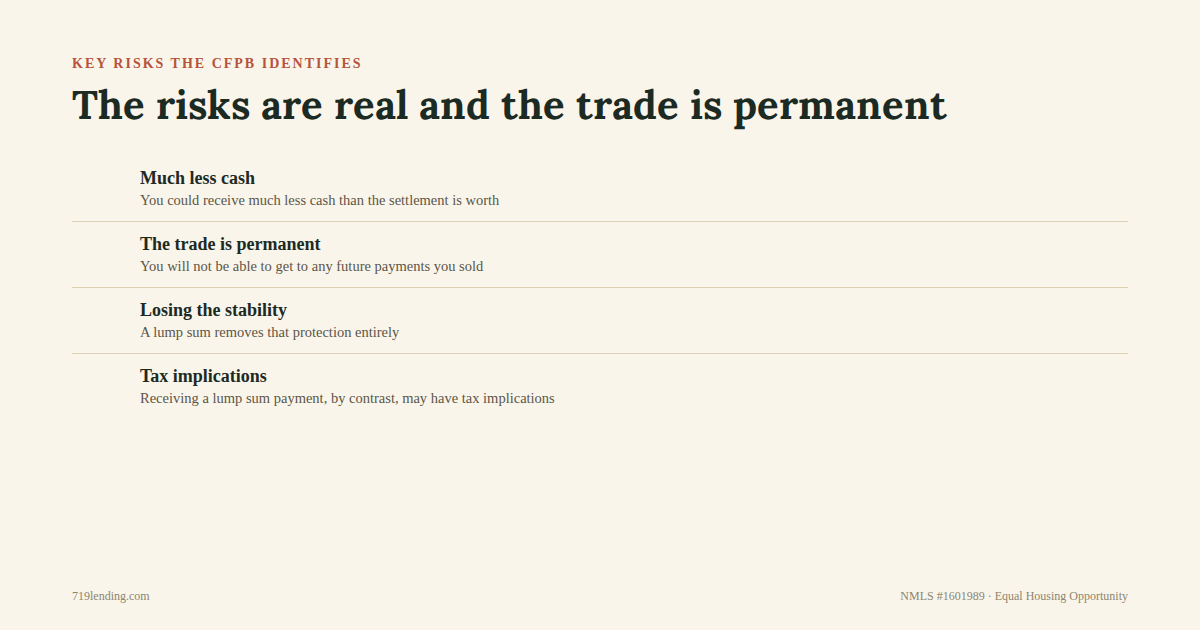
Selling structured settlement payments usually works like this: you get one lump sum payment up front, and in exchange you permanently give up your right to receive the payments under the structured settlement.
The future payments you would have received go to the company that took over your structured settlement. You will not be able to get to any of those future payments later, no matter how your circumstances change.
Why the lump sum is usually less
While receiving a large amount of money all at once may be helpful in the moment, in the long run you will get a lot less money than the settlement would have paid out over time.
Monthly or periodic payments can also give you more stability to manage your finances, pay your rent or mortgage, and keep up with your bills.
If you do take a lump-sum payment, the CFPB says to make sure you have a plan for covering your monthly expenses without the benefit of the structured settlement payments you gave up.
Before you get anywhere near that decision, the CFPB lays out a checklist of questions to answer first.
Questions to answer before trading periodic payments for a lump sum
The Consumer Financial Protection Bureau’s guidance boils down to one theme: get everything in writing and get independent advice before you sign.
Do you have other options?
If you are having trouble paying bills and see a lump sum payment as a way out of debt, first contact your creditors to see if you can work something out.
If hospital bills are the pressure point, check whether the hospital has a charity care program or another way of providing free or reduced prices, and learn your rights around negotiating with debt collectors.
What are the costs?
Get a written statement from the company that wants your structured settlement. The CFPB says it should spell out the total of all your remaining payments, the value in today’s dollars of that total, the number of payments remaining, the lump sum you would receive, and all fees, interest or discount rate, and costs.
Then get a second opinion or an independent evaluation from a trusted source, your own attorney, or a financial adviser. Be cautious of recommendations that come from the company trying to acquire your structured settlement.
What is the cancellation policy?
Depending on your state law, you may have the right to cancel or rescind the agreement within a certain time frame, even after you signed. Get your cancellation rights in writing before you consider signing anything.
What about taxes?
Your monthly structured settlement payments may be tax-free, but receiving a lump sum payment may have tax implications.
Tax treatment varies by situation, so consult a tax advisor before signing. Do not rely on the purchasing company’s characterization of the tax consequences.
Will public benefits be affected?
If you receive public benefits, or plan to in the future, getting a lump sum payment may impact your eligibility.
Check with your lawyer, your local legal aid office, or the department that administers those benefits before you commit.
What does state law require?
Nearly all states require a judge to approve an agreement to give up a structured settlement. Court approval often means the judge must decide whether the deal is in your best interest or is necessary, reasonable, or appropriate.
Your state law may also require certain disclosures before you sign. Check with your state Attorney General’s office or state consumer protection office to confirm the company is licensed to do business in your state and to look for complaints.
Those protections exist for a reason. They are also relevant if the settlement payments play a role in your bigger financial picture, including a home purchase.
Structured settlements and your mortgage picture
Steady periodic payments can be part of the income story you present when you apply for a home loan.
Here is the practical point for Colorado buyers: permanently trading a dependable payment stream for a one-time lump sum changes the finances you will bring to a future mortgage application.
Before giving up structured settlement payments to fund a down payment or pay off debt, it is worth talking through the full picture with a 719 Lending loan officer alongside your attorney and a tax professional, so you understand what you are giving up and what you are actually solving.
Whatever you decide, anchor it to the official guidance rather than a sales pitch.
What the official source says and where to read it
This article is based on the Consumer Financial Protection Bureau’s consumer guidance titled “What should I know before giving up my monthly disability, personal injury, or structured settlement payments in exchange for a one-time lump sum payment?” It is available on the CFPB website at consumerfinance.gov.
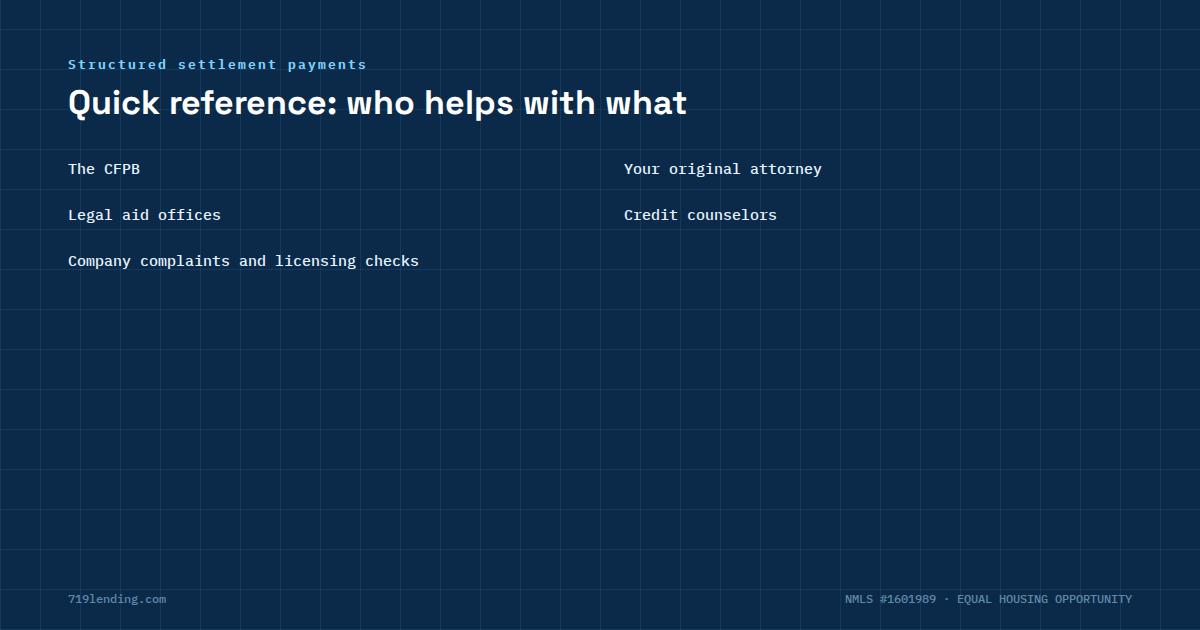
The CFPB also points to resources for free or low-cost help: the lawyer who represented you in the original matter, lawyer resources from the American Bar Association, your local legal aid office or volunteer attorney program, and non-profit credit counselors through the Financial Counseling Association of America or the National Foundation for Credit Counseling.
With the authoritative guidance in hand, the next steps are concrete and short.
What to do next
If you hold a structured settlement and someone is offering you a lump sum for it, do not sign anything yet.
First, get the company’s written statement of your remaining payments, their value in today’s dollars, the lump sum offered, and every fee and cost. Second, get an independent evaluation from your own attorney or a financial adviser, and check the company with your state consumer protection office.
Third, confirm the tax and public-benefits consequences with the right professionals. And if homeownership is part of your plan, reach out to 719 Lending in Colorado Springs before you trade away future payments, so the decision fits the rest of your financial life. You can also browse more plain-English explainers in our education library.
Frequently asked questions
What is a structured settlement in simple terms?
A structured settlement pays out money from a settled or won personal injury claim as regular, tax-free periodic payments over a specified length of time, instead of one lump sum payment. Schedules can be monthly, quarterly, semi-annual, annual, or a set number of lump-sum payments.
Is a structured settlement the same as SSDI or SSI?
No. Structured settlement payments are sometimes called disability payments because they compensate for injuries, but they are not government-provided Social Security Disability Insurance (SSDI) or Supplemental Security Income (SSI) payments.
Can I sell my structured settlement payments for cash?
Companies do offer lump sum payments for some or all of your future structured settlement payments, but selling means permanently giving up those payments, and you will generally receive a lot less than the settlement is worth over time. Nearly all states require a judge to approve the agreement.
Are structured settlement payments tax-free?
The CFPB notes that monthly structured settlement payments may be tax-free, while a lump sum payment may have tax implications. Tax treatment varies by situation, so consult a tax advisor before making any changes.
Do I need court approval to give up a structured settlement?
Nearly all states require a judge to approve an agreement to give up structured settlement payments. The judge may need to decide whether the deal is in your best interest or is necessary, reasonable, or appropriate, and state law may require certain disclosures before you sign.
What should a company disclose before buying my structured settlement?
Get a written statement showing the total of your remaining payments, the value in today’s dollars of that total, the number of payments remaining, the lump sum you would receive, and all fees, interest or discount rate, and costs. Then get an independent evaluation from your own attorney or financial adviser.
719 Lending Inc., NMLS #1601989 · Equal Housing Opportunity
719 Lending Inc. is not affiliated with or endorsed by HUD, FHA, VA, USDA, CHFA, the CFPB, or any government agency.
Last updated: October 2026

Related Posts