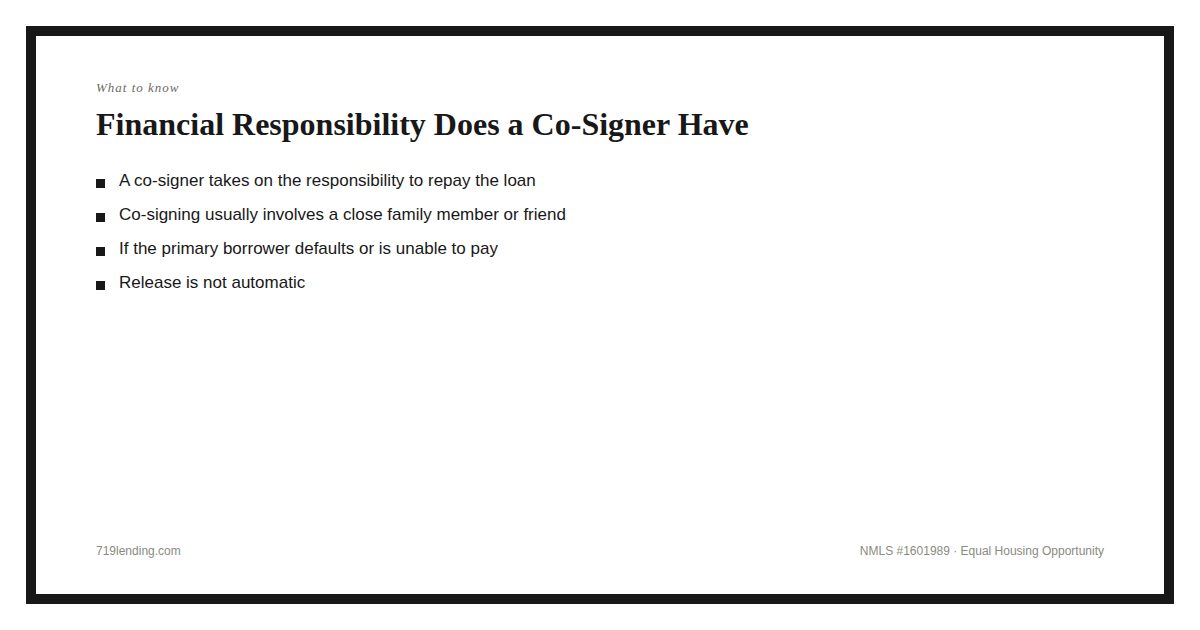
Cosigning a loan means you are equally responsible for the debt. If the primary borrower defaults, the lender can report the missed payments on your credit, send a collection agency after you, and even sue you. Here is exactly what can happen, what the Consumer Financial Protection Bureau says, and what to do before things get that far.
What Components Are Included in the Total of Payments?
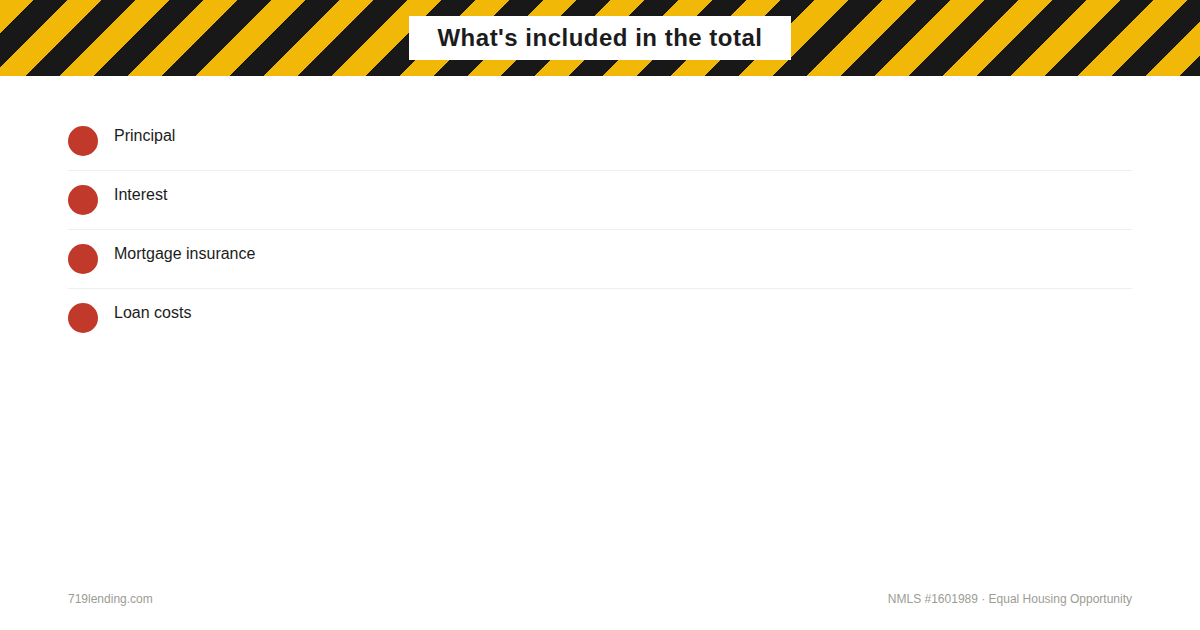
If you’re asking what components are included in the total of payments figure, here’s the direct answer: principal, interest, mortgage insurance (if applicable), and loan costs. This article walks through each component, shows you exactly where the figure appears in your mortgage paperwork, and explains how borrowers in Colorado Springs and across Colorado can use it when weighing loan offers.
What components are included in the total of payments figure?
According to the Consumer Financial Protection Bureau, the total of payments includes four pieces:
- Principal — the amount you borrowed and have to pay back
- Interest — what the lender charges for lending you the money
- Mortgage insurance — included only if the loan carries it
- Loan costs — the costs associated with getting the loan
Added together, these tell you the total amount of money you will have paid over the life of the mortgage.
The figure assumes one specific scenario: you make each monthly payment exactly as agreed — no more and no less — until the very end of the loan term. Next, let’s look at each component on its own.
Breaking down the four components

The total of payments is a sum, and each piece of that sum answers a different question about the cost of borrowing. Understanding them separately makes the combined figure far more useful.
Principal
Principal is the money you actually borrowed. Every scheduled payment chips away at this balance until it reaches zero at the end of the loan.
The total of payments counts every dollar of principal you repay, because repaying what you borrowed is part of what the loan costs you over time.
Interest
Interest is the charge for borrowing the money. It is calculated over the full term of the loan, so a longer repayment period generally means more total interest flows into the total of payments figure.
This is often the component that surprises first-time buyers, because the lifetime interest on a long-term mortgage adds up across decades of scheduled payments.
Mortgage insurance, if applicable
Some loans include mortgage insurance and some do not. When a loan carries it, those premiums are folded into the total of payments.
Whether your specific loan includes mortgage insurance depends on the program and the structure of the loan, which is something to confirm with your loan officer before you compare offers.
Loan costs
Loan costs are the fourth component. These are the costs tied to obtaining the mortgage itself, and they appear in the total alongside the payments you make month after month.
Now that you know what goes into the number, the next question is where to actually find it.
Where to find the total of payments on your paperwork
The total of payments appears on page 5 of the Closing Disclosure, in the section labeled Loan Calculations. The Closing Disclosure is the final form you receive before closing on most home loans.
If you’re working through the mortgage process with 719 Lending, your loan officer can walk you through page 5 line by line so nothing on the form is a mystery at the closing table.
Some loans, however, don’t use a Closing Disclosure at all — and that changes where the figure lives.
Which loans don’t get a Closing Disclosure?
The CFPB notes that you will not receive a Loan Estimate or Closing Disclosure if you are shopping for certain products:
- A reverse mortgage
- A home equity line of credit (HELOC)
- A manufactured housing or mobile home loan not secured by real estate
- A subordinate loan through certain types of homebuyer assistance programs
For these kinds of loans, you should receive Truth-in-Lending disclosures instead. On a Truth in Lending disclosure, the total of payments appears in the top section of the form.
Extra documents for reverse mortgages
If you are shopping for a reverse mortgage, you will also receive a Good Faith Estimate (GFE) and a HUD-1 or HUD-1A Settlement Statement in addition to Truth-in-Lending disclosures.
Knowing which document set applies to your loan tells you where to look. The next thing to understand is the assumption baked into the number itself.
The key assumption behind the total of payments
The total of payments assumes you make each monthly payment as agreed — no more and no less — until the end of the loan. That assumption matters more than most borrowers realize.
If you pay the loan off early
The figure models a loan held to full term. If you sell the home, refinance, or pay extra toward principal, your actual lifetime cost will differ from the printed number.
That’s especially relevant in a military market like Colorado Springs, where PCS orders can move a family long before a mortgage reaches its final payment. Service members stationed at the local installations often own a home for a handful of years, not the full loan term.
Why the figure is still useful
Even if you don’t keep the loan to the end, the total of payments puts every offer on the same footing. Two loans compared under the same hold-to-term assumption reveal real structural differences in cost.
Just as important as knowing what’s in the figure is knowing what’s left out of it.
What the total of payments does not include
The total of payments is a loan-cost figure, not a cost-of-homeownership figure. The CFPB explains that your total monthly payment usually includes additional costs beyond principal and interest — like homeowners insurance and taxes — and those behave differently.
Property taxes and homeowners insurance
For most borrowers, the monthly payment sent to the mortgage company includes homeowners insurance and taxes that may be held in an escrow account. The mortgage company typically holds that money in escrow until the insurance and tax bills come due, then pays them on your behalf.
Escrow amounts can also change over time. For example, if your home increases in value, your property taxes typically increase as well — something many Colorado homeowners have experienced firsthand as home values in the state have shifted.
HOA, condo, and co-op fees
If you live in a condo, co-op, or a neighborhood with a homeowners’ association, you will likely have additional fees that are usually paid separately. Those fees sit outside both the total of payments and, typically, your monthly mortgage payment.
Not every loan has an escrow account
Many lenders require you to pay taxes and insurance in advance using an escrow account, but not all do. If there’s no escrow payment listed on your Loan Estimate, you’ll pay property taxes directly to your state or local government and homeowners insurance directly to your insurance company.
Understanding that boundary — loan costs inside the figure, ownership costs outside it — sets up the smartest way to use the number when shopping.
How to use the total of payments when comparing offers
The total of payments is one of several tools for comparing loans side by side. It shows lifetime cost under identical assumptions, which cuts through differences in how offers are presented.
Pair it with the projected payments section
The CFPB recommends looking at the total monthly payment listed on the written estimates you receive. You can find the estimated total monthly payment on page 1 of the Loan Estimate, in the Projected Payments section.
Many homebuyers make the mistake of looking at just the principal and interest payment, then get an unpleasant surprise when the total monthly payment turns out to be higher.
Compare apples to apples on escrow
If one lender requires you to pay taxes and insurance into an escrow account but another doesn’t, the CFPB suggests comparing the offers by looking at the principal and interest payment instead of the total monthly payment — then calculating the full monthly cost yourself so you know you can afford it.
Your real estate agent can point you to local property tax and insurance information so the math reflects your actual Colorado property. With the comparison framework in hand, here’s how to put it to work.
What to do next
Start by pulling out your Loan Estimate or Closing Disclosure and finding the figures discussed here: the Projected Payments section on page 1 of the Loan Estimate, and the Loan Calculations section on page 5 of the Closing Disclosure.
If anything on those pages doesn’t add up for you, ask before you sign. A loan officer should be able to explain every line.
719 Lending works with buyers across Colorado Springs and the Front Range — including the many military families using VA loans and first-time buyers navigating these disclosures for the first time. If you’d like a plain-English walkthrough of a Loan Estimate or Closing Disclosure, reach out to the team and bring your questions.
Frequently asked questions
What four components make up the total of payments on a mortgage?
The total of payments includes principal, interest, mortgage insurance (if the loan has it), and loan costs. It represents the total amount you would pay over the life of the loan if you make every payment exactly as scheduled.
Where is the total of payments on the Closing Disclosure?
The total of payments appears on page 5 of the Closing Disclosure, in the section labeled Loan Calculations.
Does the total of payments include property taxes and homeowners insurance?
No. Property taxes and homeowners insurance are typically collected through an escrow account as part of your total monthly payment, but they are not components of the total of payments figure, which covers principal, interest, mortgage insurance if applicable, and loan costs.
Do reverse mortgages and HELOCs show a total of payments?
Reverse mortgages, HELOCs, manufactured home loans not secured by real estate, and certain subordinate homebuyer-assistance loans don’t come with a Loan Estimate or Closing Disclosure. Instead, you receive Truth-in-Lending disclosures, and the total of payments appears in the top section of that form. Reverse mortgage shoppers also receive a Good Faith Estimate and a HUD-1 or HUD-1A Settlement Statement.
What happens to the total of payments if I pay off my loan early?
The printed figure assumes you make each monthly payment as agreed until the end of the loan. If you sell, refinance, or pay extra toward principal, your actual lifetime cost will differ from the number shown on the disclosure.
Is the total of payments the same as my total monthly payment?
No. The total of payments is a lifetime figure covering principal, interest, mortgage insurance if applicable, and loan costs. The total monthly payment is what you send each month and often also includes escrowed items like homeowners insurance and property taxes.
719 Lending Inc., NMLS #1601989 · Equal Housing Opportunity
719 Lending Inc. is not affiliated with or endorsed by HUD, FHA, VA, USDA, CHFA, the CFPB, or any government agency.
Last updated: October 2026

Related Posts