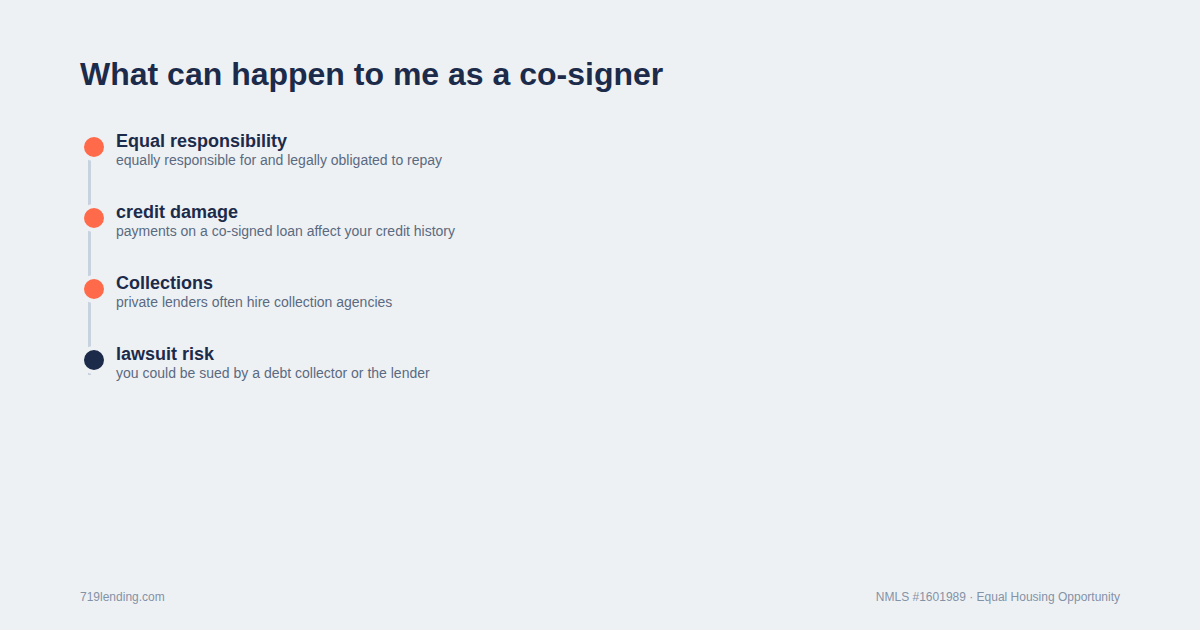
Cosigning a loan means you are equally responsible for the debt. If the primary borrower defaults, the lender can report the missed payments on your credit, send a collection agency after you, and even sue you. Here is exactly what can happen, what the Consumer Financial Protection Bureau says, and what to do before things get that far.
What Financial Responsibility Does a Co-Signer Have?
What financial responsibility does a co-signer have? In plain terms, a co-signer agrees to be financially liable for the loan if the primary borrower is unable to make payments. This article explains what that obligation means, how lenders evaluate a co-signer, and what to ask before you sign for a friend or family member — whether the debt is a private student loan, a car loan, a personal loan, or a mortgage.
Here are the key points up front:
- A co-signer is financially liable for the debt if the primary borrower cannot pay — that is the core of the arrangement.
- Lenders look at both the borrower’s and the co-signer’s credit history when evaluating the loan application.
- A co-signer with a stronger credit score can result in a lower interest rate and lower fees on the loan.
- The loan agreement — not a handshake — defines the co-signer’s exact obligations, so read it before signing.
What financial responsibility does a co-signer have?

A co-signer takes on the responsibility to repay the loan if the primary borrower does not. The Consumer Financial Protection Bureau (CFPB) puts it directly in its guidance on private student loans: a co-signer would be financially liable for the loan if the borrower is unable to make payments in the future.
That liability is the whole point of co-signing from the lender’s perspective. The lender is not asking for a reference — it is asking for a second person legally obligated on the debt.
Many people describe co-signing as being equally responsible for the loan, and the practical takeaway is the same: if the primary borrower stops paying, the lender can turn to the co-signer for the money.
With the core answer established, it helps to understand who typically ends up in this position.
Who co-signing applies to
Co-signing usually involves a close family member or friend. Parents often co-sign for young people with a thin credit history, and spouses or relatives co-sign for borrowers working to rebuild after a low credit score.
Co-signing comes up across many kinds of credit — private student loans, car loans, personal loans, apartment leases, and sometimes home loans. The CFPB’s co-signer guidance is written in the context of private student loans, but the underlying principle of liability is what you should weigh in any co-signing decision.
The Colorado Springs and military angle
In a military market like Colorado Springs, co-signing requests are common. Junior service members early in their careers may have steady income but a short credit history, and a parent or family member is often asked to co-sign.
PCS moves add a wrinkle: the primary borrower may relocate across the country while the co-signer remains tied to the debt. Distance does not change the co-signer’s financial responsibility.
Next, here is how lenders actually look at a co-signer during underwriting.
How lenders evaluate a co-signer
When a loan application includes a co-signer, the lender reviews the credit history of both people. According to the CFPB, lenders will look at your credit history and your co-signer’s credit history when evaluating the application.
That review is how the co-signer helps get the loan approved. The lender is pricing risk, and a second obligated party with a solid credit score changes the risk picture.
How a co-signer’s credit score affects the loan
The CFPB notes that if the co-signer has a better credit score than the borrower, it could result in a lower interest rate and lower fees on the loan. That is why borrowers sometimes add a co-signer even when they could qualify on their own.
Interest rates and fees on a private student loan, for example, are based primarily on credit history or credit score — so the stronger profile on the application matters.
What the co-signer should review first
Before signing, a prospective co-signer should pull their own credit report and understand the obligation they are adding. The loan agreement will describe the debt, the payments, and what the cosigner agrees to.
Understanding the evaluation is one thing; the harder question is what happens when payments stop.
What happens if the primary borrower misses payments
If the primary borrower defaults or is unable to pay, the co-signer’s liability becomes real. The lender can look to the co-signer for repayment of the loan.
Missed payments are where co-signing relationships get strained. The co-signer may learn about trouble only after it has already started, which is why communication between borrower and co-signer matters as much as the paperwork.
Read the loan agreement for the specifics
The loan agreement governs the details: how late fees work, how the lender notifies each party, and what counts as default. Those terms vary by lender, so confirm them in writing rather than assuming.
If the loan in trouble is a mortgage, the CFPB advises reaching out to the mortgage servicer and a HUD-approved housing counselor as the first steps — that applies whether you are the borrower or the person who co-signed.
Protecting the co-signer’s credit
Because the co-signer is liable on the debt, how the account is handled can affect the co-signer’s own credit standing. Ask the lender directly how the account and any missed payments are reported, and monitor your credit report so nothing surprises you.
Which raises the question most co-signers eventually ask: can you ever get off the loan?
Can a co-signer be released from the loan?
Release is not automatic. Whether a co-signer can be removed depends on the lender and the terms of the loan agreement, so the answer starts with asking the lender what, if anything, the contract allows.
The CFPB specifically addresses the question of whether a co-signer on a private student loan can be released, which tells you this is a common enough concern that the federal consumer agency publishes guidance on it.
Whether that works depends on the borrower qualifying on their own.
Before any of that becomes necessary, the smartest move is asking hard questions up front.
Questions to ask before co-signing
Treat a co-signing request like taking on the debt yourself, because legally you are agreeing to stand behind it.
- Can the primary borrower realistically make regular payments from current income?
- What does the loan agreement say about default, late fees, and notification?
- How will the account be reported, and how can I monitor it?
- Does the lender offer any path to co-signer release, and what are the conditions?
- Am I prepared to repay this debt in full if the borrower cannot?
If any answer makes you uneasy, that is information. Once those questions are settled, verify everything against the official source.
What the official source says and where to read it
The Consumer Financial Protection Bureau is the federal agency that implements and enforces federal consumer financial law. Its guidance on private student loans and co-signers states plainly that a co-signer is financially liable for the loan if the borrower is unable to make payments.
For home loans, the CFPB’s mortgage resources cover reading a monthly statement, why a payment might change, and what to do if you are having trouble paying — including contacting the servicer and a HUD-approved housing counselor.
With the rules clear, here is the concrete next step.
Your next step
If someone has asked you to co-sign, read the full loan agreement, review your own credit report, and get the lender’s answers in writing before you commit. If you already co-signed and the account is in trouble, contact the lender now rather than waiting.
If the loan in question is a mortgage — co-signing for a family member or adding a co-borrower on a purchase in Colorado Springs — talk with a loan officer at 719 Lending about how the application would be structured and what each person on the loan is responsible for.
Frequently asked questions
Is a co-signer legally responsible for the loan?
Yes. According to the Consumer Financial Protection Bureau, a co-signer is financially liable for the loan if the primary borrower is unable to make payments. The lender can look to the co-signer for repayment of the debt.
Does co-signing a loan affect my credit?
Because the co-signer is liable on the debt, the account can affect the co-signer’s credit standing. Ask the lender how the account and any missed payments are reported, and monitor your own credit report while the loan is open.
Why would a borrower add a co-signer if they already qualify?
The CFPB notes that if the co-signer has a better credit score than the borrower, it could result in a lower interest rate and lower fees on the loan, since lenders evaluate both parties’ credit history.
Can a co-signer be removed from a loan later?
It depends on the lender and the loan agreement. The CFPB publishes guidance on co-signer release for private student loans, and some borrowers refinance the debt in their own name once they qualify alone — ask the lender what the contract allows.
What should a co-signer do if the primary borrower stops paying?
Contact the lender immediately to understand the status of the account and your obligations. If the loan is a mortgage, the CFPB recommends reaching out to the mortgage servicer and a HUD-approved housing counselor.
719 Lending Inc., NMLS #1601989 · Equal Housing Opportunity
719 Lending Inc. is not affiliated with or endorsed by HUD, FHA, VA, USDA, CHFA, the CFPB, or any government agency.
Last updated: October 2026

Related Posts