Cosigning a loan means you are equally responsible for the debt. If the primary borrower defaults, the lender can report the missed payments on your credit, send a collection agency after you, and even sue you. Here is exactly what can happen, what the Consumer Financial Protection Bureau says, and what to do before things get that far.
What Does ‘Total of Payments’ Mean on a Mortgage?
If you’re asking what the ‘total of payments’ number represents in a mortgage, here is the direct answer: it is the total amount of money you will have paid over the life of the loan if you make every monthly mortgage payment exactly as agreed. This guide explains where the number lives, what it includes, how it differs from your total monthly payment, and how Colorado borrowers can use it when comparing mortgage options.
What does the ‘total of payments’ number represent in a mortgage?
The total of payments tells you the full cost of the mortgage from the first payment to the last. It is a life-of-the-loan figure, not a monthly one.
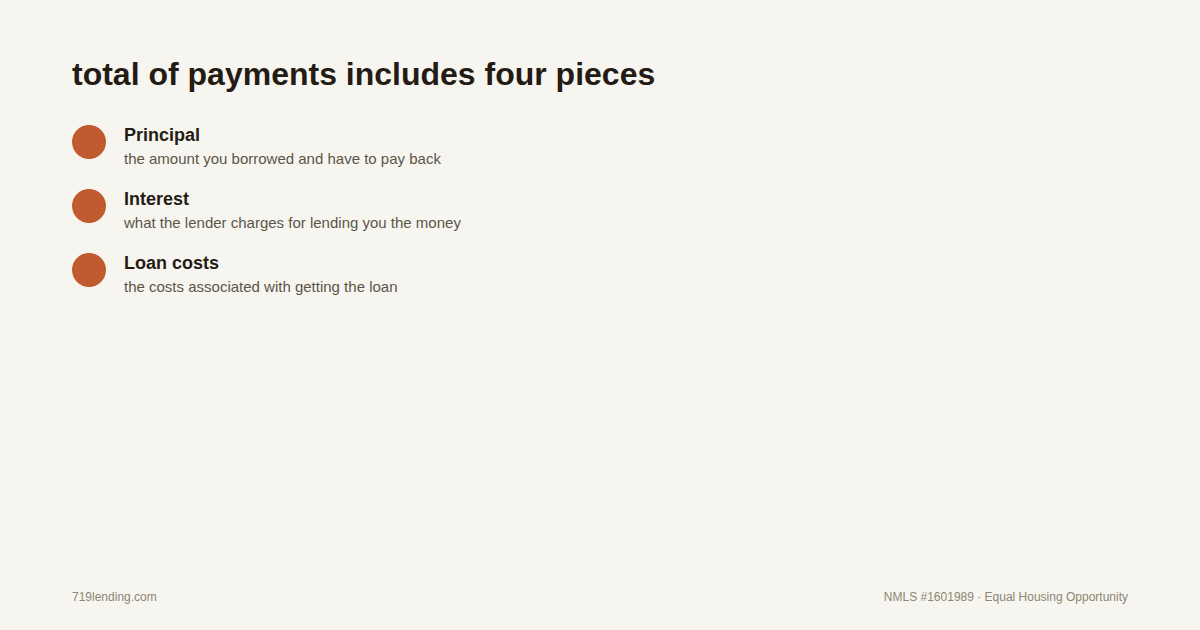
According to the Consumer Financial Protection Bureau (CFPB), the total includes principal, interest, mortgage insurance (if applicable), and loan costs. It is the clearest single picture of what borrowing money for a home will actually cost you over the full loan term.
The number rests on one key assumption: that you make each monthly payment as agreed — no more and no less — until the end of the loan. Next, let’s look at exactly where this figure appears in your paperwork.
Where do you find the total of payments?
The total of payments is found on page 5 of the Closing Disclosure form, in the section labeled Loan Calculations.
The Closing Disclosure
The Closing Disclosure is the final set of loan terms you receive before closing. It sits alongside the Loan Estimate, which you receive earlier in the process when you’re still shopping.
Both documents exist so you can see the cost of borrowing in writing before you sign anything. The Loan Calculations section is where the life-of-the-loan math is summarized.
The Loan Calculations section
In that section, the total of payments appears alongside other summary figures about the loan. If anything in that section is unclear, ask the lender or loan officer to walk you through it line by line before closing.
Not every loan comes with a Closing Disclosure, though — which brings us to the exceptions.
Which loans don’t get a Loan Estimate or Closing Disclosure?
The CFPB notes that you will not receive a Loan Estimate or Closing Disclosure if you are shopping for certain products.
The exceptions
- A reverse mortgage
- A home equity line of credit (HELOC)
- A manufactured housing or mobile home loan not secured by real estate
- A subordinate loan through certain types of homebuyer assistance programs
Where the number appears instead
For these kinds of loans, you should receive Truth-in-Lending disclosures. The total of payments appears in the top section of the Truth in Lending disclosure.
If you are shopping for a reverse mortgage, you will also receive a Good Faith Estimate (GFE) and a HUD-1 or HUD-1A Settlement Statement.
Now that you know where to look, let’s break down what the number actually contains.
What’s included in the total of payments?

The total of payments bundles together the major components of your mortgage cost over the full loan term.
Principal
Principal is the amount you borrowed — the loan amount itself. Every scheduled mortgage payment chips away at the principal balance until the loan balance reaches zero at the end of the loan term.
A larger down payment means a smaller principal loan amount at the start, which flows directly into a smaller total of payments.
Interest
Interest is the cost of borrowing money, driven by the interest rate on the loan. Over a long loan term, interest is a major share of the total, which is why the total of payments is typically much larger than the original loan amount.
Mortgage insurance, if applicable
If the loan carries mortgage insurance — including private mortgage insurance on certain loans — those premiums are counted in the total of payments when they apply. Mortgage insurance protects the lender, and whether it applies to your specific loan is something to confirm with your loan officer.
Loan costs
Loan costs — the charges associated with originating and closing the loan — are also part of the total. This is one reason the total of payments is a more complete measure of the cost of borrowing than the interest rate alone.
Here is how those pieces line up at a glance:
| Component | What it covers | Counted in total of payments? |
|---|---|---|
| Principal | Repayment of the loan amount | Yes |
| Interest | The cost of borrowing money over the loan term | Yes |
| Mortgage insurance | Premiums, when the loan requires them | Yes, if applicable |
| Loan costs | Charges to originate and close the loan | Yes |
| Property taxes | Paid to the local government, often via escrow | Not on the CFPB’s list |
| Homeowners insurance | Insurance premiums, often paid via escrow | Not on the CFPB’s list |
That last distinction — taxes and insurance — trips up a lot of borrowers, so it deserves its own section.
Total of payments vs. your total monthly payment
The total of payments is not simply your monthly mortgage payment multiplied out. The CFPB’s list of what the total includes is specific: principal, interest, mortgage insurance if applicable, and loan costs.
Where property taxes and homeowners insurance fit
Property taxes and homeowners insurance are not on that list. Many borrowers pay property taxes and homeowners insurance premiums through an escrow account, and when they do, those amounts are folded into the total monthly payment the servicer collects.
So the monthly mortgage payment you actually write each month can be larger than the principal-and-interest portion the total of payments is built from. If you want a full picture of homeownership cost in El Paso County, budget for property taxes and homeowners insurance on top of the loan itself.
Why the monthly payment can change even on a fixed rate mortgage
The CFPB lists several common reasons a monthly mortgage payment changes. If you have an escrow account and your property taxes or homeowners insurance premiums change, the payment goes up or down with them — even on a fixed rate mortgage.
Other reasons include a temporary buydown ending, an adjustable rate mortgage adjusting, an interest-only or pay-option loan starting to require principal, private mortgage insurance amounts changing or being canceled, or new fees from the servicer.
Those moving parts are exactly why the total of payments carries its core assumption, which we’ll unpack next.
The big assumption behind the number
The total of payments assumes you make each monthly payment as agreed — no more and no less — until the end of the loan. Real life rarely follows that script.
Extra payments change the math
Extra payments toward the principal balance pay off the loan faster, which means less interest accrues over the life of the loan. The disclosed total of payments doesn’t model that; it models the scheduled path.
Selling or refinancing changes it too
Most borrowers don’t hold one mortgage to the final payment. That’s especially true in Colorado Springs, where PCS moves in and out of Fort Carson, Peterson, and Schriever mean many military homeowners sell or refinance well before the loan term ends.
If you refinance or sell, the loan ends early and the actual amount you paid differs from the disclosed total. Still, the number earns its place as a comparison tool — here’s how.
Why the total of payments matters when comparing loans
Two loans with similar monthly payments can have very different life-of-the-loan costs. A longer loan term can mean a lower monthly payment but more total interest; a shorter term works the other way.
The total of payments puts those tradeoffs on one line, in writing, so you can compare several factors at once and make informed decisions instead of judging a loan by the monthly payment alone.
Once the loan closes, the useful document shifts from the disclosure to the monthly statement.
Keeping track after closing: statements and servicers
Your mortgage servicer sends information you can use to stay on top of the mortgage payment, usually through a monthly statement.
What the statement shows
A mortgage statement contains customer service contact information for the mortgage servicer, the amount due, the due date, the interest rate, and fees and charges, along with information about any past-due amounts if the loan is delinquent.
Review the statement each time it arrives. That habit helps you spot problems quickly and avoid penalties from missed or misapplied payments.
Coupon books and other notices
Not everyone receives a periodic statement. Some servicers send coupon books — usually mailed once a year — with payment slips you tear out and return with payment, and they may include only the servicer’s contact information, your account information, and the amount due.
The CFPB also suggests considering automatic payments through the servicer or your bank or credit union to help you stay on track. If a payment changes and you believe the servicer made a mistake, call first, take detailed notes, and send a written notice of error to the servicer’s designated address if the phone call doesn’t resolve it.
With the mechanics covered, here’s where this guidance comes from and what to do next.
What the official source says and where to read it
This article is based on the Consumer Financial Protection Bureau’s consumer guidance. You can read the CFPB’s own explanation of the total of payments on a mortgage, its guidance on managing a monthly mortgage payment, and its breakdown of why a monthly mortgage payment changes.
The CFPB is a federal agency that implements and enforces federal consumer financial law. Its pages are general consumer information, not legal advice — and 719 Lending is an independent mortgage broker, not a government agency.
Next steps for Colorado borrowers
When you receive a Loan Estimate or Closing Disclosure, turn to the Loan Calculations section and find the total of payments before you sign. Compare it across any loan options you’re weighing, and ask the loan officer to explain how principal, interest, mortgage insurance, and loan costs each contribute.
Then look separately at property taxes and homeowners insurance, since those escrow items shape the total monthly payment you’ll actually live with.
If you’re buying or refinancing in Colorado Springs — whether you’re a first-time buyer or managing a PCS timeline — reach out to the team at 719 Lending and we’ll walk through the disclosures with you line by line.
Frequently asked questions
Where do I find the total of payments on my mortgage documents?
The total of payments is on page 5 of the Closing Disclosure form, in the Loan Calculations section. For loans that don’t come with a Closing Disclosure — such as a reverse mortgage or a HELOC — look in the top section of the Truth in Lending disclosure instead.
Does the total of payments include property taxes and homeowners insurance?
The CFPB’s definition lists principal, interest, mortgage insurance (if applicable), and loan costs. Property taxes and homeowners insurance are not on that list, even though they’re often collected through an escrow account as part of your total monthly payment.
Is the total of payments the same as the loan amount?
No. The loan amount is the principal you borrow. The total of payments adds interest, mortgage insurance when it applies, and loan costs on top of principal, so it is typically much larger than the original loan amount.
What happens to the total of payments if I make extra payments?
The disclosed figure assumes you make each monthly payment exactly as agreed — no more and no less — until the end of the loan. Extra payments toward the principal balance pay the loan off faster, so your actual lifetime cost would come in below the disclosed total.
Why did my monthly mortgage payment change if my total of payments was fixed at closing?
Common reasons include changes to property taxes or homeowners insurance premiums paid through an escrow account, a temporary buydown ending, an adjustable rate mortgage adjusting, private mortgage insurance changing or being canceled, or new servicer fees. Check your statement and contact your mortgage servicer if something looks wrong.
Do all home loans come with a Closing Disclosure?
No. You won’t receive a Loan Estimate or Closing Disclosure for a reverse mortgage, a home equity line of credit, a manufactured or mobile home loan not secured by real estate, or certain subordinate homebuyer-assistance loans. Those loans use Truth-in-Lending disclosures instead.
719 Lending Inc., NMLS #1601989 · Equal Housing Opportunity
719 Lending Inc. is not affiliated with or endorsed by HUD, FHA, VA, USDA, CHFA, the CFPB, or any government agency.
Last updated: October 2026

Related Posts