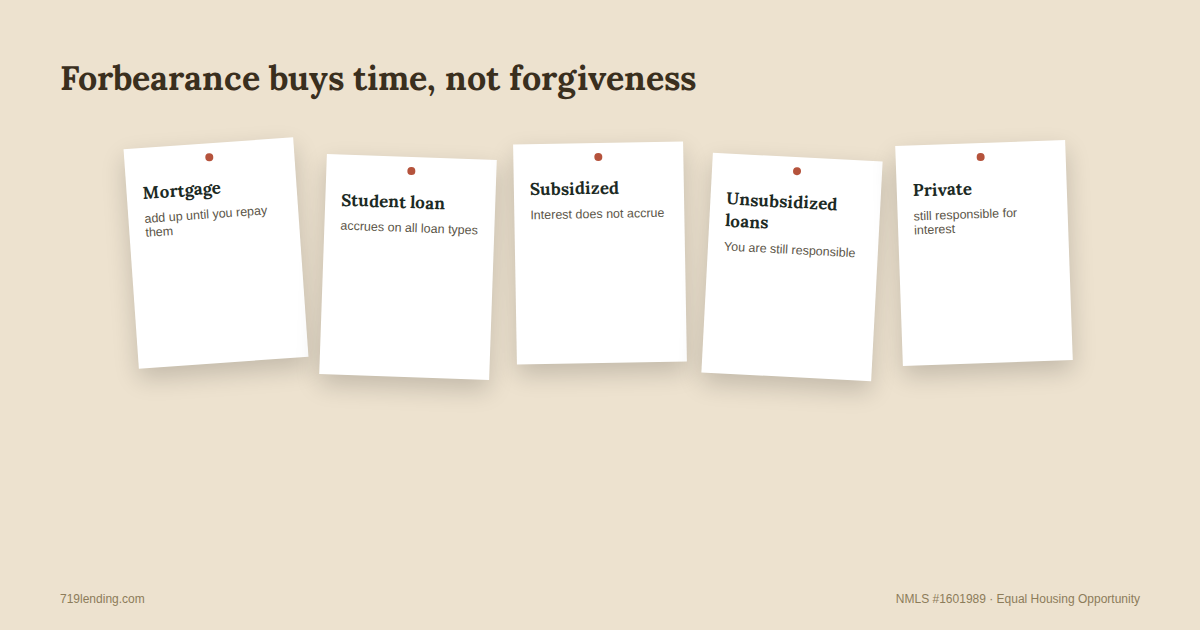
Forbearance pauses or reduces payments, but it rarely pauses interest. Here is how interest is handled during mortgage forbearance and student loan forbearance, what the Consumer Financial Protection Bureau says, and the exact questions Colorado borrowers should ask the loan servicer before agreeing to anything.
Do I Have to Pay Interest on a Subsidized Loan in Deferment?
Do I have to pay interest on my subsidized loan during deferment? The short answer is no — and that answer comes straight from the Consumer Financial Protection Bureau (CFPB). This article explains why subsidized loans get that treatment, how unsubsidized and private student loans differ, and what Colorado borrowers — especially service members — should check before pausing student loan payments.
Do I have to pay interest on my subsidized loan during deferment?
No. You do not have to pay interest on the loan during deferment if you have a subsidized loan. For all subsidized federal student loans, the U.S. Department of Education subsidizes — pays the interest on — the loan while you are in school and during periods of deferment, such as during military service.
If you have an unsubsidized loan, the rule flips: you are still responsible for the interest during deferment. If you don’t pay that interest as it accumulates, it gets added to your loan balance, which increases the overall amount you have to pay.
So the first thing to confirm is which kind of federal loan you actually have.
Subsidized vs. unsubsidized vs. private: interest during deferment
| Loan type | Interest during deferment |
|---|---|
| Federal subsidized loan | U.S. Department of Education pays the interest |
| Federal unsubsidized loan | Borrower is responsible; unpaid interest can be added to the loan balance |
| Private student loan | Borrower is generally responsible for interest that accrues; terms vary by lender and contract |

That table is the whole decision in miniature. The next sections walk through each piece.
What is a subsidized loan in the first place?
Subsidized loans are usually federal student loans. Federal subsidized loans are given to undergraduate students who demonstrate financial need.
Your school notifies you if you qualify for a subsidized loan after you complete the Free Application for Federal Student Aid (FAFSA). If you’ve already filed the FAFSA, your financial aid office can tell you whether additional paperwork is needed.
When repayment starts
Repayment on these federal loans starts six months after you graduate, leave school, or drop below half-time enrollment. During that six-month grace period, your student loan servicer sends you the repayment information.
Once repayment begins, deferment is one of the tools available if you can’t afford the payment — which is where the subsidized-loan interest benefit kicks in.
What is student loan deferment, exactly?
A student loan deferment is a temporary pause to your student loan payments for specific situations, such as active duty military service or reenrollment in school. The U.S. Department of Education publishes the list of reasons that qualify you for a federal deferment.
You apply for a deferment through your loan servicer, and you must continue making payments until you’ve been notified that the deferment was approved.
Deferment doesn’t change the loan terms
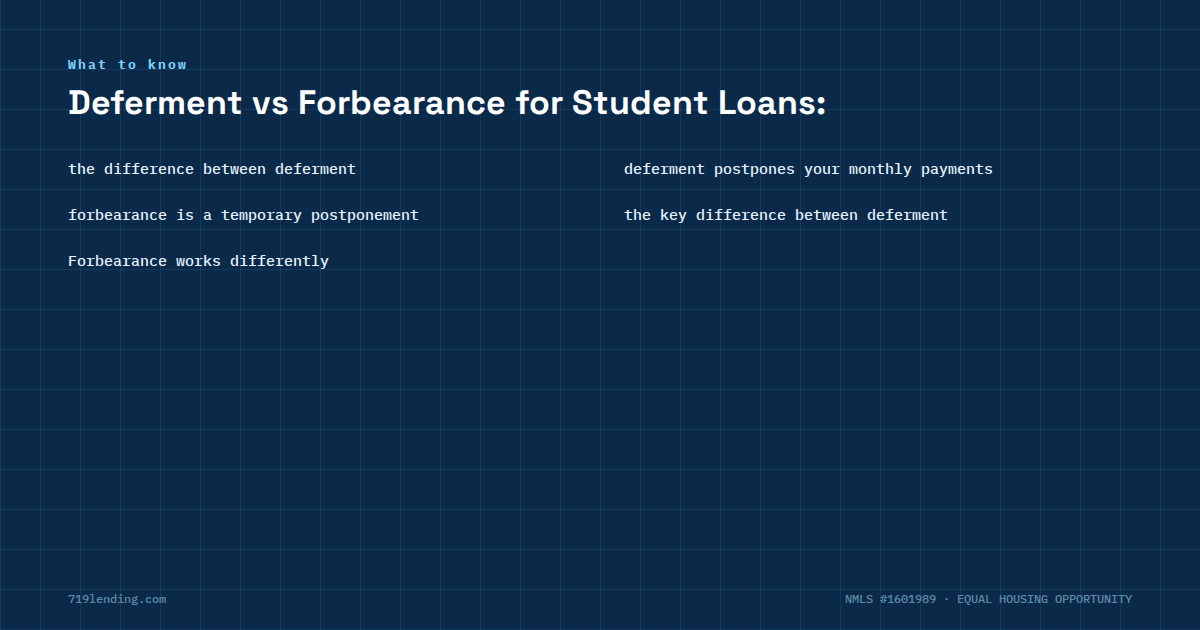
Deferment postpones your payments but doesn’t change the terms of the loan. Short-term, payments are paused; long-term, the cost of the debt probably increases — unless the loan is subsidized, in which case the government covers the interest for the deferment period.
That’s what separates deferment from its close cousin, forbearance.
How is deferment different from forbearance?
The difference between deferment and forbearance comes down to how much interest accrues over time. During a deferment, interest doesn’t accrue on some loan types — subsidized loans. During a forbearance, interest accrues on all loan types, and you are still responsible for the interest accrued.
Forbearance pauses payments and gives you a window to get back on your feet if you’re struggling. Sometimes lenders agree to reduce your debt permanently as part of a forbearance, but the interest clock keeps running either way.
Both tools can also affect your progress toward Public Service Loan Forgiveness (PSLF), so understand that trade-off before you pause.
What about military service and other public service?
This question comes up constantly in Colorado Springs, where PCS moves and deployments from the local installations regularly disrupt household budgets. Federal loans may be eligible for deferment or forbearance while you serve in the military, volunteer in the Peace Corps, or participate in a national service program.
But the CFPB cautions that a pause can be a short-term fix that makes paying back student loans more expensive, and points to other repayment options worth comparing first.
Benefits to check before you pause
- Income-driven repayment (IDR) plans — including Income-Based Repayment (IBR), Income-Contingent Repayment (ICR), Pay As You Earn (PAYE), and Saving on a Valuable Education (SAVE) — for borrowers with federal Direct Loans, with potential interest benefits and monthly progress toward loan forgiveness.
- The Servicemembers Civil Relief Act (SCRA), which may lower the interest rate on pre-service loans.
- Perkins loan cancellation, which some servicemembers and Peace Corps volunteers may qualify for.
Check your eligibility for these benefits before consolidating your loans — otherwise, you could lose eligibility. Private student loans follow their own rules entirely.
Do private student loans have a deferment option?
Private student loans may or may not have a deferment option, and the rules vary among lenders. Unlike some federal student loans, you are generally still responsible for the interest that accrues on private loans during a deferment or forbearance.
The terms and fees for postponing private student loan payments depend on your contract and applicable law, and may not be as favorable as the deferment or forbearance terms on federal loans. Many borrowers are surprised to find their loan balance has grown once they finish their service and begin repaying.
Contact your loan servicer as early as possible if you want to explore this option — the same next step the CFPB recommends across the board.
What the official source says and where to read it
The answer in this article comes from the Consumer Financial Protection Bureau’s Ask CFPB pages on student loan deferment, subsidized loans, and repayment during military and national service. Those pages are general consumer information, not legal advice, and the CFPB updates them periodically.
If you have a problem with a student loan, you can submit a complaint to the CFPB online.
What to do next
Start by confirming whether each of your student loans is subsidized, unsubsidized, or private — the interest treatment during deferment hinges entirely on that. Then contact your loan servicer, ask about every benefit available for your situation, and keep making payments until a deferment is formally approved.
And if a home purchase is on your horizon in Colorado, how your student loans are handled shows up in your overall debt picture. The team at 719 Lending can walk through how deferred or active student loan payments fit into a mortgage application, so you can plan both debts together.
Frequently asked questions
Does interest accrue on subsidized loans during deferment?
No. During a deferment, the U.S. Department of Education pays the interest on federal subsidized student loans. Interest does not accrue against your balance for a subsidized loan while an approved deferment is in place.
Do I pay interest on an unsubsidized loan during deferment?
Yes. With an unsubsidized loan, you’re still responsible for the interest during deferment. If you don’t pay it as it accumulates, it’s added to your loan balance, increasing the total amount you have to repay.
What’s the difference between deferment and forbearance?
The difference is interest. During deferment, interest doesn’t accrue on some loan types — subsidized loans. During forbearance, interest accrues on all loan types, and you remain responsible for it.
Can I defer my student loans during active duty military service?
Federal loans may be eligible for deferment or forbearance during military service. The CFPB also points servicemembers to income-driven repayment plans, SCRA interest-rate benefits on pre-service loans, and Perkins loan cancellation — check eligibility with your servicer before consolidating.
Do private student loans pause interest during deferment?
Generally no. Private student loans may or may not offer a deferment option, and you’re typically still responsible for interest that accrues during the pause. Terms depend on your contract and vary by lender.
How do I apply for a student loan deferment?
Apply through your loan servicer and keep making payments until you’re notified the deferment is approved. The U.S. Department of Education publishes the list of situations that qualify for a federal deferment.
719 Lending Inc., NMLS #1601989 · Equal Housing Opportunity
719 Lending Inc. is not affiliated with or endorsed by HUD, FHA, VA, USDA, CHFA, the CFPB, or any government agency.
Last updated: October 2026

Related Posts