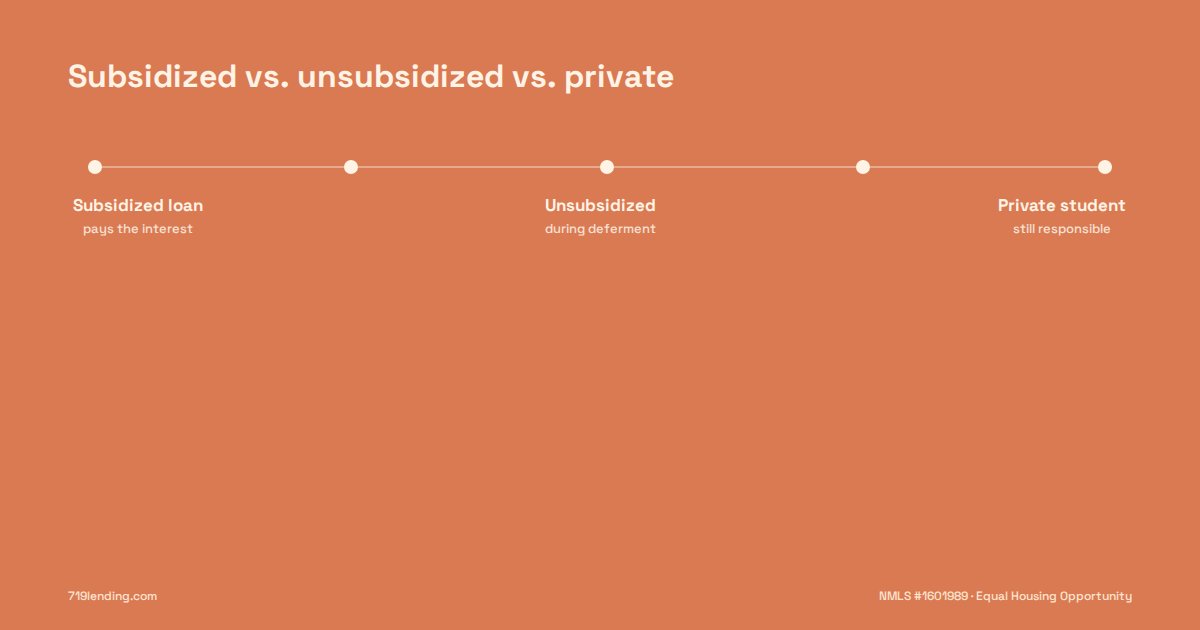
If you have a federal subsidized student loan, you do not have to pay interest on it during an approved deferment — the U.S. Department of Education covers it. Unsubsidized and private student loans work differently, and the gap matters, especially for service members around Colorado Springs weighing deferment during active duty.
Am I Still Responsible for Interest During Forbearance?
Am I still responsible for interest during forbearance? In most cases, yes. Forbearance pauses or shrinks payments, but it generally does not pause interest, and it never erases what you owe.
This guide covers how interest is handled during mortgage forbearance and during student loan forbearance, based on Consumer Financial Protection Bureau (CFPB) guidance. It is written for Colorado borrowers, including the many military families around Colorado Springs who juggle a mortgage and student loans at the same time.
- Mortgage forbearance pauses or reduces payments, but you still owe the full amount and repay the difference later.
- Interest on paused or reduced mortgage amounts can continue to add up until you repay them.
- On federal student loans, interest accrues on all loan types during forbearance.
- During deferment, subsidized federal loans do not accrue interest; unsubsidized loans do.
- On private student loans, you are generally still responsible for interest during deferment or forbearance.
| Situation | Are you responsible for the interest? |
|---|---|
| Mortgage forbearance | Yes — interest on paused or reduced amounts can continue to add up until repaid |
| Federal student loan forbearance | Yes — interest accrues on all loan types |
| Deferment on subsidized federal loans | No — interest does not accrue during deferment |
| Deferment on unsubsidized federal loans | Yes — you are still responsible for the interest |
| Private student loan deferment or forbearance | Generally yes — interest typically keeps accruing |
Am I still responsible for interest during forbearance?
Yes, as a rule. The CFPB states it plainly for student loans: you are still responsible for the interest accrued during a forbearance, and during a forbearance, interest accrues on all loan types.
The mortgage answer rhymes with the student loan answer. Mortgage forbearance does not erase or decrease the amount you owe, you have to repay any missed or reduced payments, and interest on those amounts could continue to add up until you repay them.
The one meaningful carve-out involves deferment, not forbearance. On subsidized federal student loans, interest does not accrue during a deferment — but that is a different arrangement with different rules.

So the honest short answer is: forbearance buys time, not forgiveness. The next question is which kind of forbearance you are actually dealing with.
Who this question applies to
Homeowners ask this when a hardship hits — the CFPB lists examples like a home damaged in a natural disaster, unexpected medical expenses, or a job loss. Forbearance exists for exactly that kind of financial hardship.
Student loan borrowers ask it when money gets tight and pausing monthly student loan payments looks tempting. Servicemembers, Peace Corps volunteers, and other public servants ask it around deployments and service commitments.
In the Colorado Springs market, it often comes up around a PCS move: a service member leaves Fort Carson or Peterson Space Force Base, income shifts, and both the mortgage payment and the student loan payments come under pressure at once.
Whichever camp you are in, the mechanics below determine how much the pause ultimately costs. Start with the mortgage side.
How interest works during mortgage forbearance
Mortgage forbearance is a process your servicer or lender arranges so you temporarily pause mortgage payments or make smaller payments. You still owe the full amount, and you pay back the difference later.
The CFPB describes three common structures, and interest behaves slightly differently in each. In every version, ask the servicer directly how interest accrues during the forbearance period — the bureau specifically tells borrowers to keep asking until they understand that point.
Paused payments repaid in a lump sum
The servicer lets you stop making payments for a specified number of months. When payments restart, you pay the whole missed amount back at once.
Two things to weigh: you owe a big bill that comes due at one time, and interest on the paused amounts could continue to add up until you repay them.
Paused payments moved to the end of the mortgage
Here, payments pause for a specified number of months, and the missed amount is repaid either by adding more payments at the end of the loan or by taking out a new loan.
Adding missed payments at the end means the mortgage could extend longer than the original term. Repaying with a new loan means that loan comes due all at once at the end of the mortgage term. Either way, interest on the missed amounts could continue to add up until repaid.
Reduced payments repaid during the loan term
In this version, the servicer reduces the monthly payment for a specified number of months. Afterward, the reduced amounts are spread across a set number of months and added to the regular payment, so monthly payments increase for that stretch.
Again, interest on any reduced amounts could continue to add up until you repay them. That consistent theme — interest keeps running — is the core of the answer, and it carries straight over to student loans.
How interest works during student loan forbearance
Student loan forbearance pauses payments and gives you a window to get back on your feet if you are struggling. Sometimes lenders agree to reduce the debt permanently as part of a forbearance, but that is the exception, not the rule.
The rule is this: you are still responsible for the interest accrued during a forbearance, on every loan type. Many borrowers are surprised to discover their student loan debt has grown once they finish a period of service and begin repaying their loans.
Forbearance vs. deferment on federal loans
Deferment postpones payments without changing the terms of the loan. Short-term, payments are paused; long-term, the cost of the debt probably increases.
The CFPB draws the line clearly: during a deferment, interest does not accrue on some types of loans, while during a forbearance, interest accrues on all loan types. That difference in accrued interest over time is the whole distinction that matters for cost.
Subsidized vs. unsubsidized loans
If you have a subsidized federal student loan, you do not have to pay interest during a deferment. If you have an unsubsidized loan, you are still responsible for the interest during deferment.
During forbearance, that subsidized protection disappears — interest accrues regardless. If you are deciding between the two options, the loan servicer can confirm which of your federal loans are subsidized.
Private student loans
Private student loans may also offer deferment or forbearance under certain circumstances. Unlike some federal student loans, you are generally still responsible for the interest that accrues during either one.
Contact the loan servicer before postponing payments on private loans, and ask exactly how the accrued interest will be handled when regular payments resume. Before you pause anything, though, it is worth knowing what the federal system offers instead.
Alternatives federal student loan borrowers should check first
The CFPB cautions that while deferment or forbearance can be a short-term fix, either could make paying back your loans more expensive. There may be repayment options worth reviewing first.
Income-driven repayment plans
Borrowers with federal Direct Loans can look at an income-driven repayment (IDR) plan, such as Income-Based Repayment (IBR), Income-Contingent Repayment (ICR), Pay As You Earn (PAYE), or Saving on a Valuable Education (SAVE).
On an IDR plan, the monthly payment is based on income, there may be interest benefits that prevent the balance from growing due to unpaid interest, and borrowers working in public service make progress toward loan forgiveness each month they are enrolled.
The CFPB also notes that choosing deferment or forbearance can affect your ability to receive credit toward Public Service Loan Forgiveness (PSLF) — a point worth confirming with the servicer before you pause payments.
Benefits for servicemembers and public servants
Servicemembers may be able to lower the interest rate on pre-service loans under the Servicemembers Civil Relief Act (SCRA). Peace Corps volunteers and servicemembers with a Perkins loan may be able to have that loan canceled.
Check eligibility for these benefits before consolidating loans — consolidating first could cost you the eligibility. Ask the student loan servicer directly about all benefits available to borrowers engaged in public service. With alternatives mapped, here is how to actually start the forbearance conversation.
How to request forbearance from the servicer
For a mortgage, call the mortgage servicer and explain your situation immediately. Ask what forbearance or hardship options are available.
Some mortgage servicers require that forbearance or hardship assistance be requested within a specified amount of time after a disaster or other qualifying event, so do not wait on this call.
Keep asking questions until you understand three things: the amount you must pay and how long payments are paused or reduced, how interest accrues during that time, and when and how you pay back the paused or reduced amounts.
For student loans, the same principle applies: contact the loan servicer to learn about your options before you decide to postpone making payments. Knowing where the official guidance lives helps you verify everything they tell you.
What the official sources say and where to read them
This article is built on CFPB guidance. The bureau’s mortgage forbearance page explains the three repayment structures and confirms that forbearance does not erase or decrease the amount owed.
Its student loan guidance confirms that interest accrues on all loan types during forbearance, and that only subsidized federal loans escape interest during deferment.
The CFPB also points homeowners to U.S. Department of Housing and Urban Development (HUD)-certified housing counselors, who can discuss options if you are having trouble paying the mortgage. Reverse mortgage borrowers can contact a HUD-approved reverse mortgage counseling agency.
If you are facing foreclosure or have been served legal papers, resources may be available through the local bar association or legal aid. Servicemembers can contact their local Legal Assistance Office — a resource many Colorado Springs military families have close at hand.
What to do next
If the mortgage is the problem, call the servicer today, describe the hardship, and get the forbearance terms — including exactly how interest accrues and how repayment works — in writing before you agree.
If student loans are the problem, ask the student loan servicer about income-driven repayment and public-service benefits before choosing forbearance, since interest accrues on all loan types once a forbearance starts.
And if you are sorting out how a past or current forbearance fits into a future home purchase or refinance in Colorado, talk with a 719 Lending loan officer about your full picture. You can also browse our mortgage education library or learn more about how 719 Lending works with Colorado borrowers before you reach out.
Frequently asked questions
Does interest accrue during mortgage forbearance?
Generally, yes. The CFPB notes that interest on paused or reduced mortgage amounts could continue to add up until you repay them. Ask the mortgage servicer exactly how interest accrues under the specific forbearance plan offered, and get the answer in writing.
Do I have to pay back the payments I missed during forbearance?
Yes. Mortgage forbearance does not erase or decrease the amount you owe. Depending on the plan, missed payments are repaid in a lump sum when payments restart, added to the end of the mortgage or repaid through a new loan, or spread across higher monthly payments for a set period.
Does interest accrue on subsidized student loans during forbearance?
Yes. During a forbearance, interest accrues on all federal student loan types, including subsidized loans. Subsidized loans only avoid interest during a deferment, which is a separate arrangement with different rules.
Am I responsible for interest on private student loans during forbearance?
Generally, yes. The CFPB says that unlike some federal student loans, borrowers are generally still responsible for the interest that accrues on private student loans during a deferment or forbearance. Contact the loan servicer to confirm how the accrued interest will be handled.
How do I request mortgage forbearance?
Call the mortgage servicer immediately and explain the hardship. Some servicers require that forbearance or hardship assistance be requested within a specified time after a disaster or qualifying event. Keep asking questions until you understand the payment terms, how interest accrues, and how repayment works.
Can forbearance affect Public Service Loan Forgiveness?
It can. The CFPB advises borrowers to understand how deferment or forbearance affects their ability to receive credit toward Public Service Loan Forgiveness before pausing payments. Borrowers with federal Direct Loans can ask the servicer about income-driven repayment plans, which count toward forgiveness each month of enrollment.
719 Lending Inc., NMLS #1601989 · Equal Housing Opportunity
719 Lending Inc. is not affiliated with or endorsed by HUD, FHA, VA, USDA, CHFA, the CFPB, or any government agency.
Last updated: October 2026

Related Posts