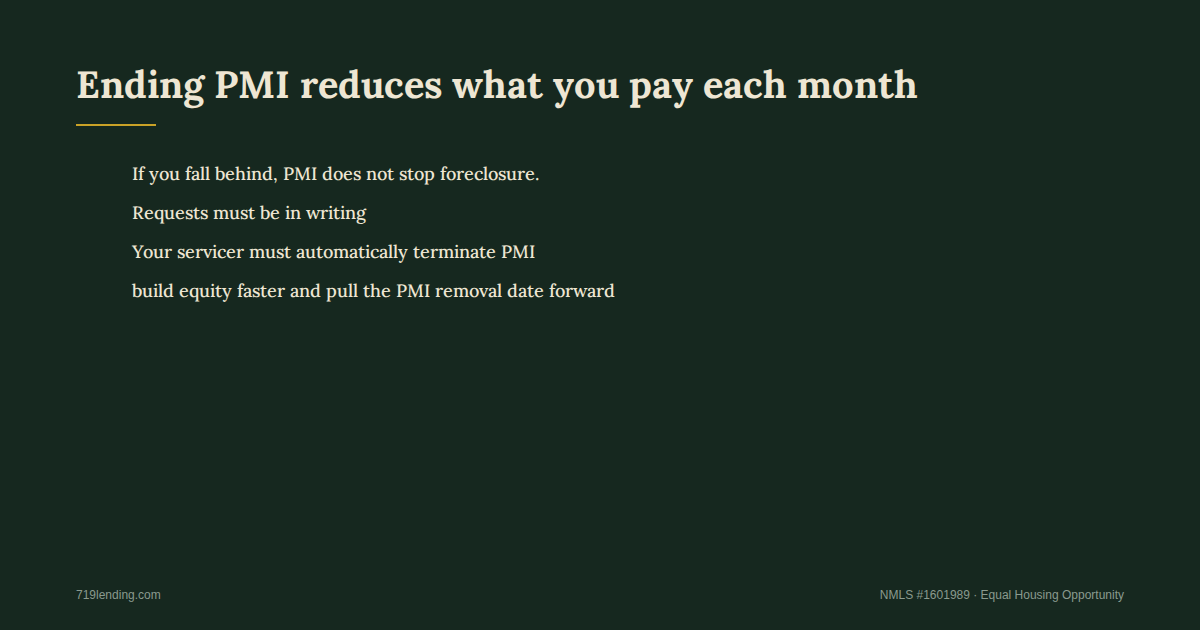
Private mortgage insurance protects the lender, not you, and it adds to your monthly mortgage payment. Here is the main benefit of removing PMI, when federal law says you can cancel it, and the exact steps Colorado homeowners can take to request PMI removal from their servicer.
What Happens If You Make a Partial Mortgage Payment?
What happens if my lender receives only a partial mortgage payment from me? It depends on the servicer’s written policy — the lender may reject the payment, hold it in a separate account without applying it to the loan, add late fees, and report the shortfall to the credit bureaus. This guide explains each outcome, where the rules are disclosed, and what to do if a full payment is out of reach this month. It is written for Colorado homeowners, including the many military families around Colorado Springs whose pay timing can shift during a move.
Here is the short version, drawn from the Consumer Financial Protection Bureau’s Closing Disclosure explainer:
- Your lender may not accept a partial payment at all.
- Even if the lender accepts partial payments, it may hold them in a separate account instead of applying them to your loan.
- The lender may charge you a late fee every month until you make up the difference.
- The lender may report you to the credit reporting agencies as not making your required payment.
- Your loan’s partial payment policy is disclosed on your Closing Disclosure, so you can look it up before you ever borrow.
What happens if my lender receives only a partial mortgage payment?

A partial payment is any amount less than the full monthly payment your mortgage servicer expects on the due date. Sending most of the payment is not the same as sending all of it.
The Consumer Financial Protection Bureau (CFPB) spells out four possible outcomes in its official Closing Disclosure explainer. First, the servicer may simply not accept the partial payment.
Second, even a servicer that accepts partial mortgage payments may hold the money in a separate account instead of applying it to the loan. Third, late fees can be charged every month until the difference is made up. Fourth, the servicer may report you to the credit reporting agencies as not having made your required payment.
Which of those outcomes you face depends on the servicer and the loan documents — which is why the next question is what your specific loan says.
What counts as a partial payment on a mortgage?
The full monthly payment on most mortgage loans includes more than principal and interest. Per the CFPB, principal is the amount you borrowed and interest is the lender’s charge for lending you money, and the total monthly payment is often higher because it includes items such as property taxes and homeowners insurance collected through an escrow account.
That matters because a payment that covers principal and interest but skips the escrow portion is still a partial payment. The servicer measures your payment against the full amount on the mortgage statement, not against the pieces you consider most important.
Even on a fixed-rate loan, the total monthly payment can change over time because taxes or insurance change. If you keep paying an old amount after the payment adjusts, the servicer may treat the shortfall as a partial payment.
So the first step is always confirming the current full payment amount — then you can understand where a short payment actually lands.
Where does a partial payment go? The suspense account explained
When a servicer accepts a partial payment but does not apply it to the loan, the money typically sits in a holding account. Many servicers refer to this as a suspense account, though the CFPB describes it simply as a separate account — check your mortgage statement or servicing agreement for the exact term your servicer uses.
How a suspense account works
Money in a suspense account is not credited against principal, interest, or escrow. From the loan’s perspective, the payment has not been made, even though the servicer is holding your cash.
Only when the suspense account holds enough to cover a full payment — because you sent the rest of the money — does the servicer apply the funds to the loan. Until then, the account can keep accruing late fees and the loan can keep showing as unpaid.
Why suspense accounts surprise borrowers
The confusing part is that the money left your bank account, so the payment feels made. But if it is sitting in suspense, the outstanding balance, the interest, and the delinquency status all behave as if you paid nothing that billing cycle.
That is why the CFPB’s advice is blunt: ask questions so you understand exactly what happens if you can’t make a payment in full. And the fee side of the equation deserves its own look.
Can late fees stack up on a partial payment?
Yes. According to the CFPB, a lender that receives partial payments may charge a late fee every month until you make up the difference.
Notice the phrasing: every month. A single short payment can generate repeated late fees if the shortfall carries forward, because each new month the full payment technically remains unpaid.
The amount of the late fee is set out in your loan documents and disclosed before closing. The CFPB recommends knowing in advance how much the fee will be if a payment is late, precisely because fees are one of the two big consequences — the other being your credit.
Will a partial mortgage payment hurt my credit?
It can. The CFPB states that the lender may report you to the credit reporting agencies as not making your required payment, even if it accepted and is holding your partial payment.
In other words, a partial payment sitting in a suspense account does not protect your credit report. The servicer’s reporting is based on whether the full payment was received, not on whether some money arrived.
The CFPB’s guidance is that making mortgage payments on time and in full, every month, is how you avoid fees and improve your credit record. If a full payment is genuinely impossible one month, the goal shifts to communicating with the servicer before the shortfall snowballs — because in the worst case, sustained nonpayment puts the home itself at risk.
Can partial payments lead to foreclosure?
Every mortgage includes a security interest. The CFPB explains that the security interest is what allows the lender to foreclose on your home if you don’t pay back the money you borrowed.
A single partial payment does not put you in foreclosure. But partial payments that never get made whole become missed payments, and missed payments are the path that leads toward foreclosure over time.
The practical takeaway: treat a partial payment as a warning light, not a workaround. The sooner you talk to the servicer or a housing counselor, the more room you have to fix the shortfall — and the first place to look for your loan’s exact rules is a document you already have.
Where is my loan’s partial payment policy written down?
The Closing Disclosure
Lenders are required to provide a Closing Disclosure before your scheduled closing, and it contains a specific section answering the question: will your lender accept partial monthly mortgage payments?
That same document discloses the late fee terms, whether you have an escrow account, the loan term, the interest rate on the loan, and whether the loan has features like a prepayment penalty or balloon payment. The CFPB’s Closing Disclosure explainer walks through the form line by line.
If you are buying now, use the review window to actually read this section. If something is different from what you expected, the CFPB’s advice is to ask the lender why before you sign — and at 719 Lending we would rather answer that question before closing than after.
Your mortgage statement and servicer
When in doubt about how a short payment would be handled, call the mortgage servicer directly and ask them to explain their partial payment policy and any suspense account practices.
Get the answer before you send the money, not after — and if the reason you are short is a bigger cash-flow problem, there is a playbook for that too.
What should I do if I can’t make the full payment this month?
Call the servicer before the due date
Servicers can only work with what they know. Explain the situation, ask whether they accept partial payments, ask where the funds will sit, and ask what fees and credit reporting will apply.
Get the answers in writing where possible, and note the name of the person you spoke with.
Ask what workout options exist
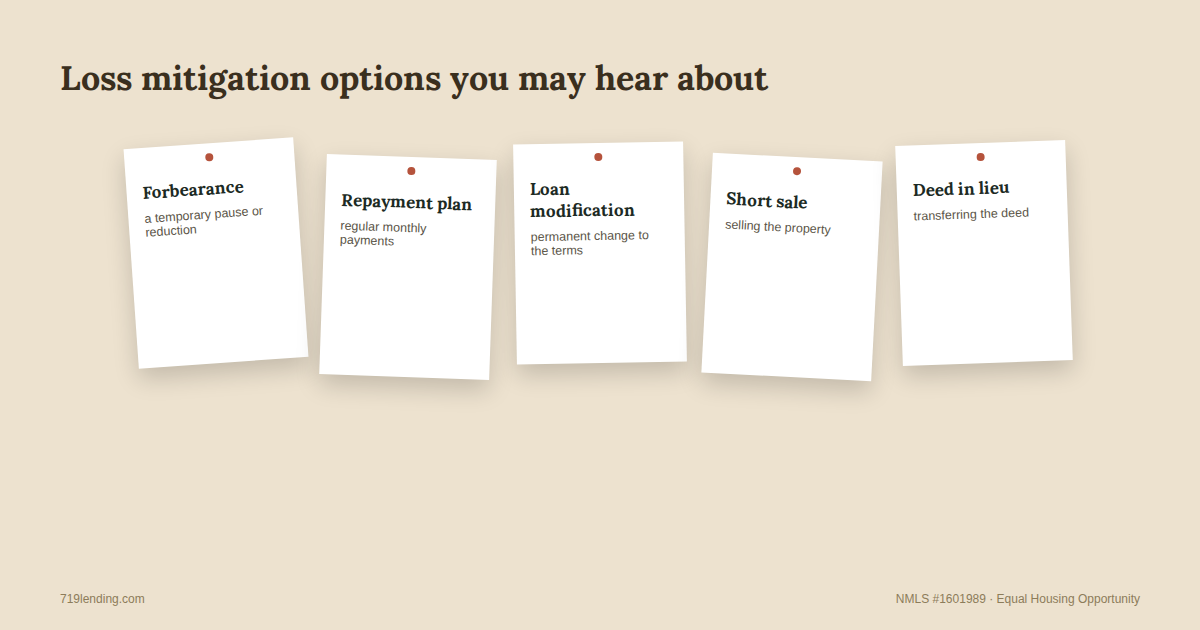
Ask the servicer directly what options are available to borrowers who are behind or about to fall behind — for example, whether a repayment plan or loan modification could apply to your situation. The specifics vary by servicer and loan, so treat these as questions to raise rather than outcomes to assume.
Talk to a HUD-approved housing counselor
The CFPB says that if you’re behind on your mortgage or having a hard time making payments, you can contact the CFPB to be connected to a housing counseling agency approved by the U.S. Department of Housing and Urban Development (HUD). The CFPB’s Find a Counselor tool lists HUD-approved agencies in your area, including Colorado.
Counseling is a resource, not an admission of failure — and it works best before the shortfall becomes a pattern. If the problem is not cash flow but a payment that changed, the next section covers that.
What if my payment went up because of escrow, taxes, or insurance?
An escrow account lets you pay homeowners insurance and property taxes monthly as part of your mortgage payment instead of in a large lump sum. When the county reassesses property taxes or the insurance company changes the premium, the escrow portion of the payment changes too.
That is a common reason Colorado borrowers accidentally send a partial payment: they set up an automatic transfer for the old amount and never updated it after an escrow shortage or premium change adjusted the bill.
Check every mortgage statement for the current full payment. If the number moved and you don’t understand why, ask the servicer to walk you through the escrow analysis.
Adjustable rate mortgages add another moving piece: per the CFPB, when the interest rate on an adjustable-rate loan adjusts, the payment is typically recalculated based on the new rate and the remaining loan term. An old autopay amount on an adjusted ARM is another quiet route to making partial payments without realizing it.
How is a partial payment different from an extra payment?
Borrowers sometimes confuse the two. A partial payment is less than the full amount due, and it triggers everything described above.
An extra payment is money sent beyond the full payment. How additional funds are applied — and whether the loan has a prepayment penalty, which is a fee some loans charge for paying off the mortgage early — is disclosed on the Closing Disclosure, so confirm the treatment with the servicer before sending extra money.
The direction of the shortfall or surplus changes everything, so always know which side of the full payment you are on. One more group needs this information most: households whose income timing moves around.
Why this matters for military families in Colorado Springs
Colorado Springs is home to Fort Carson, Peterson Space Force Base, Schriever Space Force Base, and the Air Force Academy. PCS moves, deployment pay changes, and gaps between duty stations can all disrupt the timing of household cash flow, and Basic Allowance for Housing (BAH) can change with a new assignment.
So the same advice applies with extra force: know the full payment, know the servicer’s partial payment policy in advance, and call before a move disrupts a payment rather than after.
If a PCS is on the horizon and the mortgage math is getting tight, that is also a reasonable moment to talk through the loan with a Colorado Springs loan officer and review the options.
Summary: what can happen to a partial mortgage payment
| Servicer response | What it means for you |
|---|---|
| Payment not accepted | The money is refused; the full payment remains due |
| Held in a separate (suspense) account | Funds are not applied to the loan until the full payment is complete |
| Late fee charged monthly | Fees can repeat every month until you make up the difference |
| Reported to credit reporting agencies | The loan can be reported as not paid despite the partial payment |
All four responses come straight from the CFPB’s Closing Disclosure guidance, and which ones apply to you is a function of your servicer’s policy and your loan documents.
Your next step
If you are shopping for a mortgage loan, read the partial payment and late fee sections of the Closing Disclosure before you sign, and ask the lender to explain anything that surprises you.
If you already own and a full payment is in doubt this month, call the mortgage servicer today, ask exactly how a partial payment will be handled, and connect with a HUD-approved housing counselor if you are falling behind.
And if you are in Colorado Springs and want a plain-English walkthrough of loan documents, payment structure, or what a servicer letter actually means, reach out to 719 Lending — we will read it with you and tell you what questions to ask.
Frequently asked questions
Will my lender accept a partial mortgage payment?
Maybe not. The CFPB notes that if you can’t make the full mortgage payment in a given month, your lender may not accept a partial payment at all. Whether your lender accepts partial monthly mortgage payments is disclosed on your Closing Disclosure, and your servicer can confirm its current policy.
What is a suspense account on a mortgage?
It is a holding account. When a servicer accepts a partial payment, it may hold the funds in a separate account — commonly called a suspense account — instead of applying them to your loan. The money is not credited to principal, interest, or escrow until enough arrives to complete a full payment.
Does a partial mortgage payment count as a missed payment on my credit report?
It can. The CFPB states the lender may report you to the credit reporting agencies as not making your required payment, even if it accepted the partial funds. Credit reporting is based on whether the full payment was received.
Can I be charged late fees more than once for the same shortfall?
Yes. Per the CFPB, the lender may charge you a late fee every month until you make up the difference, so a single short payment can generate repeated fees if it is never made whole.
What should I do if I can’t make my full mortgage payment?
Call your mortgage servicer before the due date, ask how a partial payment will be handled, and ask what options exist for borrowers falling behind. The CFPB can also connect you with a HUD-approved housing counseling agency in Colorado through its Find a Counselor tool.
719 Lending Inc., NMLS #1601989 · Equal Housing Opportunity
719 Lending Inc. is not affiliated with or endorsed by HUD, FHA, VA, USDA, CHFA, the CFPB, or any government agency.
Last updated: September 2026

Related Posts