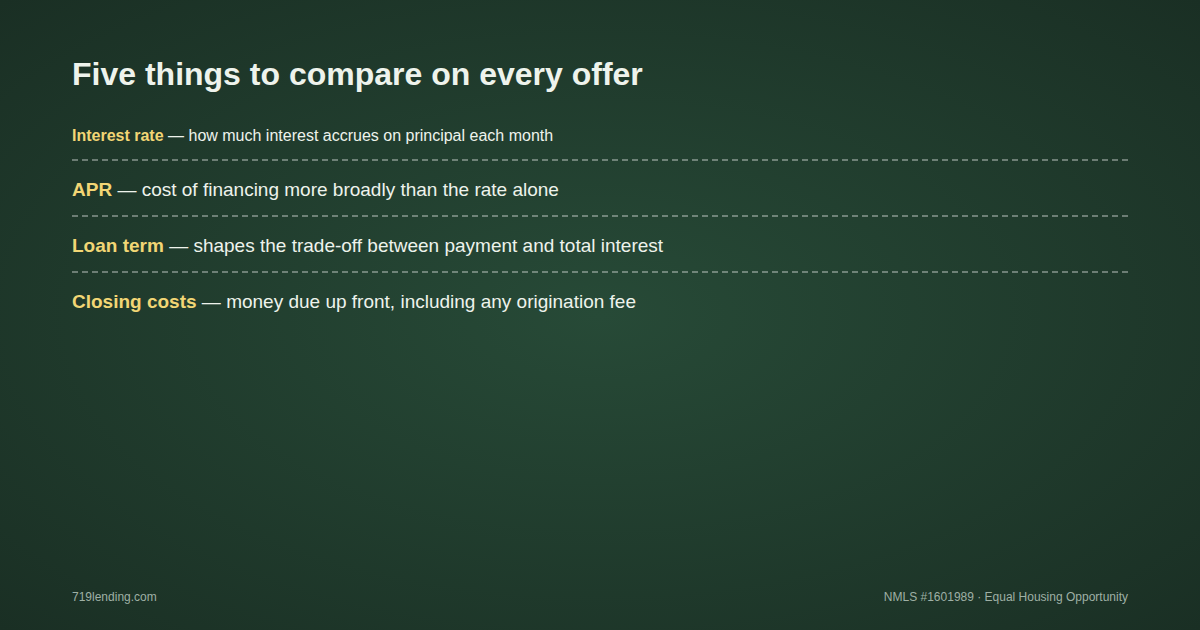
Comparing mortgage loans is not about guessing which lender sounds friendliest. It is a structured process built around the Loan Estimate, a standardized disclosure that lets you line up offers side by side. Here is how Colorado borrowers can compare interest rate, loan term, monthly payment, and fees before committing.
Does PMI Protect Me If I Can’t Pay My Mortgage? No — Here’s Why
Does PMI protect me if I can’t pay my mortgage? No — and the Consumer Financial Protection Bureau (CFPB) is blunt about it: private mortgage insurance protects the lender, not you. If you fall behind on mortgage payments, PMI does not step in, and foreclosure is still possible.
This article is for Colorado borrowers who are paying PMI — or about to — and want to know what that monthly premium actually buys. We’ll cover what private mortgage insurance really does, what to do if you can’t pay the mortgage, and how PMI cancellation works.
The quick answer, up front
- PMI protects the mortgage lender against loss when a borrower defaults on the loan.
- PMI does not pay the mortgage for you, and it does not stop foreclosure.
- Lenders require PMI on conventional loans when the down payment is below the traditional equity threshold.
- You have legal rights to cancel PMI once the loan balance pays down to specified points.
- If you can’t pay, the protections that help you are loss mitigation options from your servicer and free help from a HUD-approved housing counseling agency.
With the headline settled, let’s define what private mortgage insurance actually is.
What is private mortgage insurance (PMI)?
Private mortgage insurance (PMI) is a type of mortgage insurance you may be required to buy when you take out a conventional loan with a down payment smaller than the standard equity threshold of the home’s purchase price. The same requirement can apply when you refinance a conventional loan and your equity is below that mark.
PMI is arranged by the lender and provided by private insurance companies. It insures the lender against loss caused by borrowers failing to make loan payments.
Who benefits from PMI?
The lender covers its risk with PMI; the insurance company pays the lender, not the homeowner, if the borrower defaults. Your benefit is indirect: paying PMI can help you qualify for a conventional loan you might not otherwise get with a lower down payment.
That trade-off matters in a market like Colorado Springs, where saving a large down payment can take years. Next, the question that brought you here.
Does PMI protect me if I can’t pay my mortgage?
No. Private mortgage insurance does not protect you if you can’t pay your mortgage. In the CFPB’s words: make no mistake — if you fall behind on your mortgage payments, PMI does not protect you, and you can still lose your home through foreclosure.

PMI is not payment protection, job-loss insurance, or disability coverage. When a borrower defaults, the PMI policy reimburses the lender for its loss. The borrower still owes the debt, still faces collection, and still faces foreclosure.
Why the confusion is so common
The word “insurance” naturally suggests the person paying the premium is the one protected. With PMI, the borrower pays but the lender is the insured party. Unlike homeowners insurance, which pays you when your property is damaged, PMI pays the lender when the loan goes bad.
So why do borrowers pay for the lender’s protection at all? That comes down to how lenders price risk.
Why do lenders require PMI on conventional loans?
A smaller down payment means the borrower has less equity, so the lender absorbs more risk if the loan defaults. PMI shifts part of that risk to an insurance company, which is why lenders require PMI on conventional mortgages with a lower down payment.
Because PMI reduces the lender’s exposure, it lets financial institutions approve conventional loans for potential buyers who haven’t saved the traditional down payment amount. That widens access to homeownership, but it increases the total cost of the loan.
How do borrowers pay for PMI?
The most common structure is a monthly premium added to the monthly mortgage payment. It appears on page 1 of your Loan Estimate and Closing Disclosure, in the Projected Payments section.
Some loans use a one-time up-front premium paid at closing, shown in section B on page 2 of those disclosures. If you pay up front and later move or refinance, you might not be entitled to a refund of that premium.
A third structure combines both: an up-front premium at closing plus a monthly premium in the mortgage payment. Ask the loan officer to calculate total PMI cost over a few realistic timeframes before you choose.
Understanding the structure helps, but the sharper contrast is with the insurance you actually benefit from.
PMI vs. homeowners insurance: who gets protected
Unlike homeowners insurance, PMI never pays you. Here’s the side-by-side:
| Feature | Private mortgage insurance (PMI) | Homeowners insurance |
|---|---|---|
| Who is protected | The lender | You, the homeowner |
| What triggers a payout | Borrower defaults on the loan | Covered damage or loss to your property |
| Who receives the payout | The lender | You (or you and the lender jointly) |
| Helps if you miss mortgage payments? | No — foreclosure is still possible | No — it covers property losses, not payments |
| Can it be removed? | Yes, at legally defined equity points | Required as long as the lender requires coverage |
Since PMI won’t rescue you in a hardship, here’s what actually will.
What should I do if I can’t pay my mortgage?
If you can’t pay the mortgage — or you can see a missed payment coming — the CFPB says to call your mortgage servicer right away and contact a HUD-approved housing counseling agency for free, expert help avoiding foreclosure.
Step one: call your mortgage servicer
The servicer’s phone number is on your monthly mortgage statement, your coupon book, or the servicer’s website. Be prepared to explain why you can’t make the payment, whether the problem is temporary or permanent, and details about your income, expenses, and other assets.
If your servicer offers a mortgage assistance application, fill it out. The servicer reviews it and tells you which loss mitigation options, if any, are available to you.
Step two: get free HUD-approved counseling
Through the Department of Housing and Urban Development (HUD), you can find a housing counseling agency at little or no cost. A counselor can explain the loss mitigation options your servicer offers, guide you through the paperwork, and help with budgeting or debt problems that are squeezing the mortgage payment.
If foreclosure is imminent or you’ve been served legal papers, you may also need to consult an attorney.
A note for military borrowers
If you’re a servicemember with permanent change of station (PCS) orders, say so when you call the servicer. The CFPB notes that a military move can qualify you for loss mitigation options — relevant for many families around Fort Carson, Peterson, and Schriever facing an unexpected relocation.
Loss mitigation options your servicer may offer
Depending on your situation, options can include a refinance, a loan modification, a repayment plan, forbearance, a short sale, or a deed-in-lieu of foreclosure. A HUD-approved counselor can help you sort out which path fits.
One more protection worth knowing: the scams that target struggling homeowners.
Watch out for foreclosure rescue scams
You never have to pay anyone to help you avoid foreclosure — legitimate help is free from your servicer or a HUD-approved counseling agency.
Red flags include upfront fees, guarantees that your mortgage terms will be changed or your home saved, instructions to send payments to someone other than your servicer, pressure to sign over title, offers of a “forensic audit,” advice to stop paying your mortgage, or claims of government affiliation.
Now the good news about PMI: you don’t pay it forever.
When can I cancel PMI?
For single-family principal residences with conventional mortgages, federal law gives you the right to remove PMI once the loan pays down to specified points. Ending PMI reduces your monthly payments.
Request PMI cancellation in writing
You can request cancellation on the date the principal balance is scheduled to fall to the legal request threshold measured against the home’s original value — generally the lower of the purchase price or the appraised value at purchase. Extra principal payments can move that date up.
The servicer must grant the request if you ask in writing, have a good payment history and are current, certify there are no junior liens, and can show the property value hasn’t declined below the original value. The first eligible date appears on the PMI disclosure form you received at closing.
Automatic termination
Even if you never ask, the servicer must automatically terminate PMI when the principal balance is scheduled to reach the automatic-termination point against the original value, provided you’re current on payments. If you’re behind, termination waits until shortly after you catch up.
The loan-term midpoint rule
PMI must also end the month after you reach the midpoint of the loan’s original amortization schedule, even if the balance hasn’t hit the usual threshold — again, as long as you’re current. Loans backed by Fannie Mae or Freddie Mac may follow investor guidelines, but those can’t be less favorable than the federal rules.
Mortgages through the Federal Housing Administration (FHA) or the Department of Veterans Affairs (VA) follow different mortgage insurance rules — contact your servicer with questions on those. If you’d rather not pay PMI at all, you have options before closing.
Can I avoid paying PMI?
With a down payment at or above the standard threshold, PMI is not required on a conventional loan, and a larger down payment may also mean a lower interest rate on the loan.
Some lenders offer conventional loans with smaller down payments and no PMI, usually in exchange for a higher interest rate. Whether that costs more or less than paying PMI depends on factors like how long you plan to stay in the home — ask for detailed pricing on each option side by side.
Borrowers making a low down payment may also want to compare other loan programs, such as an FHA loan; the CFPB notes other loan types can be more or less expensive than a conventional loan with PMI depending on credit score, down payment amount, lender, and market conditions. On the tax side, ask a tax advisor — tax treatment varies by situation.
Your next step
If you’re current on the mortgage, pull out your PMI disclosure form and check your first eligible cancellation date. If you’re struggling to pay, call your servicer today and connect with a HUD-approved counselor — those are the protections that actually work for you.
Questions about PMI on a purchase, a refinance, or a cancellation request? Talk to a 719 Lending loan officer in Colorado Springs and get a clear read on your options.
Frequently asked questions
Who does PMI actually protect?
Private mortgage insurance protects the mortgage lender, not the borrower. It reimburses the lender for losses when a borrower defaults on a conventional loan. The borrower pays the premium but receives no payout and can still face foreclosure.
Will PMI make my mortgage payments if I lose my job?
No. PMI is not payment protection or job-loss insurance. If you can’t pay, call your mortgage servicer immediately and contact a HUD-approved housing counseling agency for free help with loss mitigation options like forbearance, a repayment plan, or a loan modification.
Why do I have to pay PMI if it only protects the lender?
Lenders require PMI on conventional loans with a down payment below the standard equity threshold because the loan carries more risk. PMI shifts that risk to an insurer, which is what allows the lender to approve the loan with a smaller down payment.
Is PMI the same as homeowners insurance?
No. Homeowners insurance protects you against damage or loss to your property. PMI pays the lender if the borrower defaults on the mortgage. You may carry both, but only homeowners insurance ever pays you.
When can I get rid of PMI?
You can request PMI cancellation in writing once the loan balance is scheduled to reach the legal request threshold against the home’s original value, if you’re current with a good payment history and no junior liens. Servicers must also terminate PMI automatically at a lower balance point or at the midpoint of the loan term.
What should military families do if a PCS move makes the mortgage unaffordable?
Tell your mortgage servicer about the permanent change of station orders when you call — the CFPB notes PCS orders can qualify servicemembers for loss mitigation options. A HUD-approved housing counselor can also help you weigh the choices at no cost.
719 Lending Inc., NMLS #1601989 · Equal Housing Opportunity
719 Lending Inc. is not affiliated with or endorsed by HUD, FHA, VA, USDA, CHFA, the CFPB, or any government agency.
Last updated: September 2026

Related Posts