Force-placed insurance shows up on a mortgage statement when a servicer believes the homeowner's hazard insurance has lapsed. Here is exactly when a mortgage servicer is allowed to charge for a force-placed policy, what federal rules require, and how Colorado homeowners can dispute the charge and get their own coverage recognized.
When Is a Lender Legally Required to Send a Loan Estimate?
When is a lender legally required to send me a Loan Estimate? The answer is simple and enforced by federal law: within three business days of receiving your mortgage application. This guide explains when that clock starts, what the Loan Estimate contains, which loans are exempt, and what to do if yours never shows up — written for Colorado borrowers, including the military families who make up so much of the Colorado Springs market.
When is a lender legally required to send me a Loan Estimate?

The lender is required to send you a Loan Estimate within three business days of receiving your loan application. That is the rule published by the Consumer Financial Protection Bureau, and it applies to every lender issuing covered mortgage loans.
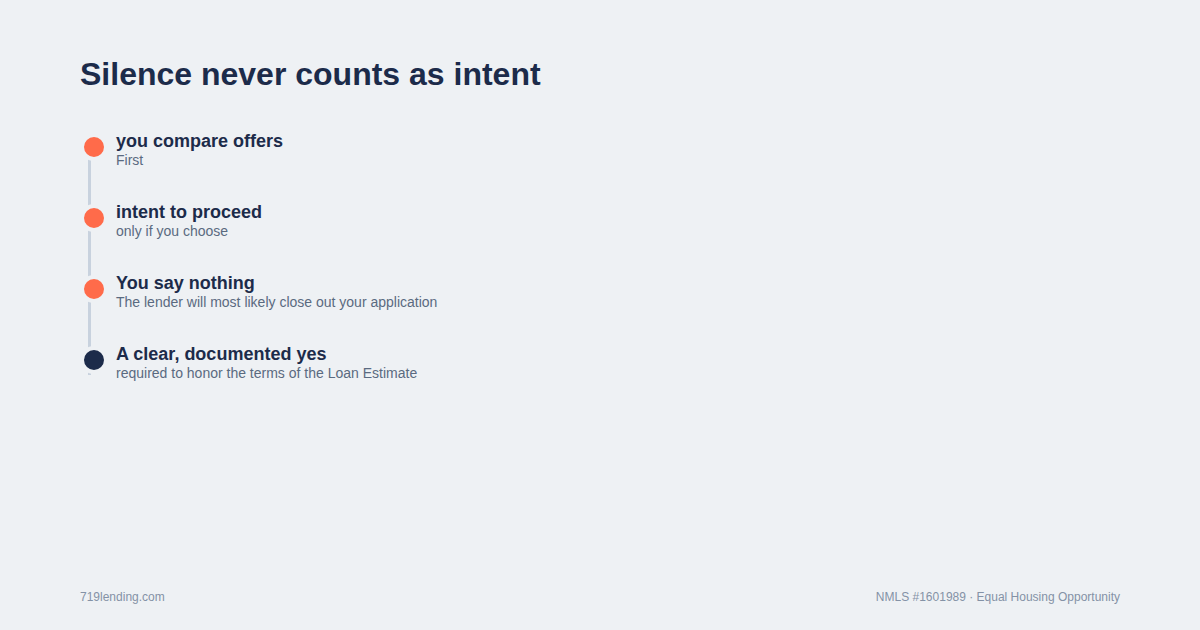
There is one exception worth knowing. The lender is not required to provide a Loan Estimate if it denies your application before the end of the third business day after receiving it.
Also important: receiving a Loan Estimate does not mean you are approved. When you receive a Loan Estimate, the lender has not yet approved or denied your loan application — the form shows the loan terms the lender expects to offer if you decide to move forward.
So the three-business-day clock is the trigger. Next, let’s look at what actually starts that clock.
What starts the three-business-day clock?
The clock starts when the lender receives your application for a mortgage loan. Submitting the application is the event that creates the legal obligation.
If you decide to move forward after receiving the Loan Estimate, the lender will ask you for additional financial information. The initial disclosure comes first; the deep documentation comes after.
What counts as an application?
If a loan officer tells you that you cannot apply and receive a Loan Estimate until you produce certain extra paperwork, that is worth questioning. The CFPB specifically addresses the claim that a signed purchase contract is required before a Loan Estimate can be issued — it maintains a consumer answer on exactly that question, which tells you the issue comes up often enough to warrant one.
If you are unsure what information you have to provide to receive a Loan Estimate, ask the lender directly and confirm the date your loan application was received. That date anchors the deadline.
Once the clock starts, the form that arrives is standardized — here’s what it looks like.
What is a Loan Estimate, exactly?
A Loan Estimate is a three-page form you receive after applying for a mortgage. It tells you important details about the loan you have requested.
The form shows the estimated interest rate, the expected monthly payment, and the total closing costs for the loan. It also covers the estimated costs of property taxes and insurance, and how the interest rate and payments may change in the future.
All mortgage lenders are required to use the same standard Loan Estimate form. That uniformity is deliberate: it makes it easier to compare loan offers side by side and choose the loan that is right for you.
Special features the form must flag
The Loan Estimate also indicates whether the loan product has special features you should know about before committing. Two called out by the Consumer Financial Protection Bureau:
- Prepayment penalty — a fee the lender can charge if you pay off the loan early. The CFPB labels this feature risky.
- Balloon payment — a final payment that is a lump sum much larger than the regular monthly payments. Also flagged as risky.
If your loan has a negative amortization feature — the loan amount increasing even when payments are made on time — it appears in the description of the loan product.
Not every loan gets this form, though, which brings us to the exemptions.
Which loans don’t come with a Loan Estimate?
You will not receive a Loan Estimate or Closing Disclosure if you are shopping for any of the following:
- A reverse mortgage
- A home equity line of credit (HELOC)
- A manufactured housing or mobile home loan not secured by real estate
- A subordinate loan through certain types of homebuyer assistance programs
For these kinds of loans, you should receive Truth-in-Lending disclosures instead. If you are shopping for a reverse mortgage, you will also receive a Good Faith Estimate (GFE) and a HUD-1 or HUD-1A Settlement Statement.
That last category matters for Colorado buyers who pair a first mortgage with a subordinate assistance loan: the first mortgage still comes with a Loan Estimate, but the assistance loan may follow the Truth-in-Lending track instead.
Here is a quick reference for the disclosure each loan type triggers:
| Loan type | Disclosure you receive |
|---|---|
| Standard mortgage loan (purchase or refinance) | Loan Estimate, then Closing Disclosure |
| Reverse mortgage | Truth-in-Lending disclosures, Good Faith Estimate, HUD-1 or HUD-1A |
| HELOC | Truth-in-Lending disclosures |
| Manufactured home loan not secured by real estate | Truth-in-Lending disclosures |
| Certain subordinate homebuyer-assistance loans | Truth-in-Lending disclosures |
If your loan is in the covered category and the form arrives on time, the next job is reading it carefully.
What should I check when the Loan Estimate arrives?
The CFPB’s Loan Estimate explainer walks through the form section by section. The short version of what to verify:
Page one: the loan terms and projected payments
- Check the spelling of your name — even minor misspellings can cause problems later.
- Check the loan term, purpose, loan product, and loan type against what you discussed with the loan officer.
- Confirm the loan amount: on a purchase, the loan amount plus your down payment should equal the sales price of the home. If it doesn’t, ask why.
- Review the monthly principal and interest, then the Estimated Total Monthly Payment, which includes mortgage insurance and escrow if applicable.
- Note whether the interest rate is fixed or adjustable, and whether the rate lock box is checked — some lenders lock the rate as part of issuing the Loan Estimate, and some do not.
Page two: closing costs
- Compare the origination charges — application, underwriting, processing, and similar fees — against Loan Estimates from different lenders. It’s the total that matters.
- Compare the Services You Cannot Shop For across lenders, since the lender chooses those providers.
- Shop the Services You Can Shop For; the lender should give you a list of approved providers.
- Check whether the loan includes points or lender credits, and confirm you discussed those choices.
- Verify the Estimated Cash to Close — the amount you bring to closing, including the down payment and closing costs, minus deposits and seller credits.
Page three: comparisons and contacts
- Confirm the loan officer listed is the one you’re working with; most loan officers are registered with the Nationwide Mortgage Licensing System (NMLS) and can be looked up by name or NMLS ID.
- Use the Comparisons section — including the loan’s APR and Total Interest Percentage (TIP) — to weigh this offer against different loan estimates for the same kind of loan.
Reviewing carefully only works if the form shows up. Here’s the playbook when it doesn’t.
What if I never received a Loan Estimate?
If you did not get a Loan Estimate within three business days of submitting a mortgage application, the Consumer Financial Protection Bureau’s guidance is direct: contact the lender and ask whether the Loan Estimate has been sent, and when it was sent.
Remember the exception — if the lender denied the application before the end of the third business day, no Loan Estimate was owed. If your application was denied, you have separate rights worth reviewing.
If the lender refuses to send one
If the lender refuses to send you a Loan Estimate, the CFPB suggests considering another lender. The disclosure rules exist so you can compare loan offers; a lender that won’t produce the form is removing your ability to shop.
You can also submit a complaint to the CFPB online or by calling (855) 411-CFPB (2372). The bureau forwards the complaint to the lender and works to get a response, generally in 15 days.
Why does the deadline matter so much? Because the Loan Estimate is your shopping tool.
Why the three-day rule matters when you’re comparing lenders
The CFPB encourages borrowers to request multiple Loan Estimates from different lenders so you can compare and choose the loan that fits. Because every lender must use the identical three-page form, the origination charges, closing costs, projected payments, and the loan’s APR line up for a true comparison.
Because loan costs vary both across lenders and across different kinds of loans, request Loan Estimates for the same loan type and loan amount from each lender you’re considering.
For military buyers in Colorado Springs, the timeline rule has practical weight: a PCS move compresses the house-hunting window, and a lender who misses the disclosure deadline compresses it further. Knowing the clock exists — and that it’s enforceable — keeps the mortgage process on schedule.
The Loan Estimate is also only the first of two major disclosures in the loan process.
Loan Estimate vs. Closing Disclosure
The Loan Estimate arrives near the start of the mortgage process and shows the loan terms the lender expects to offer.
The same loan categories that skip the Loan Estimate — reverse mortgages, HELOCs, certain manufactured home loans, and some subordinate assistance loans — skip the Closing Disclosure too, receiving Truth-in-Lending disclosures instead.
Comparing the Loan Estimate against the Closing Disclosure is how you catch changes before closing day. Which leads to the practical takeaway.
Your next step
If you’ve applied for a mortgage loan and three business days have passed without a Loan Estimate, call the lender today and ask when it was sent. If the answer is unsatisfying, you’re free to work with another lender and free to file a CFPB complaint.
If you’re earlier in the process, the move is to submit a complete mortgage application so the three-day clock starts, then review the form line by line. The 719 Lending team can walk Colorado Springs borrowers through available loan options and explain every line of the disclosure — or reach out with questions before you apply. Reading the Loan Estimate carefully before committing is the single habit that protects you most in the mortgage process.
Frequently asked questions
How many days does a lender have to send a Loan Estimate?
Three business days from the day the lender receives your mortgage application. The only exception is if the lender denies the application before the end of that third business day — then no Loan Estimate is required.
Does getting a Loan Estimate mean my loan is approved?
No. When you receive a Loan Estimate, the lender has not yet approved or denied the application. The form shows the loan terms the lender expects to offer if you move forward, and the lender will request additional financial information afterward.
Which loans don’t come with a Loan Estimate?
Reverse mortgages, home equity lines of credit (HELOCs), manufactured or mobile home loans not secured by real estate, and subordinate loans through certain homebuyer assistance programs. Those receive Truth-in-Lending disclosures instead, and reverse mortgages also get a Good Faith Estimate and a HUD-1 or HUD-1A Settlement Statement.
What can I do if my lender never sent a Loan Estimate?
Contact the lender and ask whether and when the Loan Estimate was sent. If the lender refuses to send one, consider working with another lender, and you can submit a complaint to the Consumer Financial Protection Bureau online or at (855) 411-CFPB (2372); the CFPB generally works to get a lender response in 15 days.
Can a lender require a signed purchase contract before issuing a Loan Estimate?
The CFPB publishes consumer guidance addressing exactly this claim, which is a sign the practice is questionable. If a loan officer says you can’t apply and receive a Loan Estimate without a signed contract, ask questions and consider checking the CFPB’s guidance directly.
Is the Loan Estimate the same as the Closing Disclosure?
No. The Loan Estimate arrives within three business days of application and shows expected loan terms; the Closing Disclosure arrives later with the final details of the loan before you sign. Comparing the two helps you catch changes before closing.
719 Lending Inc., NMLS #1601989 · Equal Housing Opportunity
719 Lending Inc. is not affiliated with or endorsed by HUD, FHA, VA, USDA, CHFA, the CFPB, or any government agency.
Last updated: October 2026

Related Posts