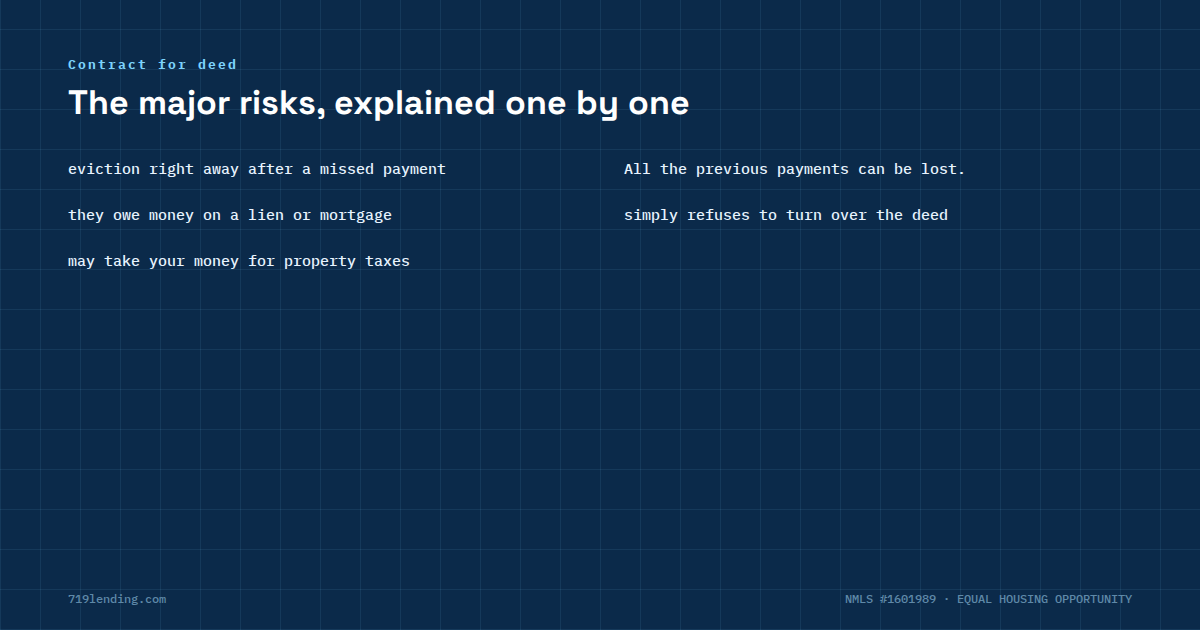
A contract for deed can look like an easy path to homeownership, but the Consumer Financial Protection Bureau warns that most carry real risks — from fast eviction after a missed payment to sellers who never hand over the deed. Here's how these arrangements work and how to protect yourself before signing.
How Is Money From a Construction Loan Provided to Borrowers?
How is money from a construction loan provided to borrowers? In a series of advances released as construction progresses — not as a single lump sum the day you close. This guide explains how home construction loans disburse money, how the construction phase differs from a traditional mortgage, and what happens when the building project is done. It is written for Colorado borrowers planning a new build or a major rehab.
How is money from a construction loan provided to borrowers?
A construction loan is usually a short term loan that provides funds to cover the cost of building or rehabilitating a home, per the Consumer Financial Protection Bureau (CFPB).
The money borrowed through a construction loan is typically provided in a series of advances as the construction progresses. Each advance — commonly called a draw — moves a portion of the loan amount out as the work moves forward.
That structure is the core difference between construction and mortgage loans used to buy an existing property. With a standard mortgage, the loan funds at closing in one transaction. With home construction loans, the money follows the work.
Next, let’s look at how that series of advances actually plays out.
How the series of advances works
Think of a construction loan as a committed pool of money that the lender releases in stages. As the construction project reaches each stage, the lender advances the corresponding portion of the loan funds.
Because disbursement is tied to progress, the construction loan process involves ongoing contact with the lender during the build — not just at the loan application and closing.
Who decides when funds are released
The lender controls the schedule of advances, and the specifics vary by lender. That is why the CFPB tells borrowers to compare multiple loans, terms, and features before committing.
Before you sign, get the draw mechanics in writing: how the lender confirms a construction milestone, whether funds go to you or to the general contractor, and how long each release takes.
Questions to ask before the first draw
Ask the lender how many advances are typical for a project like yours and what documentation triggers each release. Ask whether your construction plans and construction contract need lender review before funds move.
Also ask what happens if construction costs run over the original budget, and whether the lender requires building permits or other paperwork before it will release funds. These answers belong in your file before the construction phase begins.
Understanding the draw structure makes the next comparison easier: how a construction loan differs from a traditional mortgage.
Construction loan vs. traditional mortgage

Home construction loans and a traditional mortgage solve different problems, and the CFPB flags several structural differences.
| Feature | Construction loan | Traditional mortgage |
|---|---|---|
| Term | Usually a short term loan | A longer-term loan used to purchase a home |
| Interest rate | Generally higher than longer-term mortgage loans, per the CFPB | Generally lower than construction financing |
| How funds are provided | A series of advances as construction progresses | Funded at closing to purchase an existing property |
| How it ends | Paid off in a lump sum or converted to a conventional mortgage loan | Repaid over the loan terms |
In general, construction loans have higher interest rates than longer-term mortgage loans used to purchase homes. The interest rate quoted on any construction loan depends on the lender and your credit history, so the exact gap varies borrower to borrower.
With the structural differences clear, the next question most borrowers ask is what they pay while the home is being built.
Payments during the construction phase
Payments sometimes start on a construction loan six to twenty-four months after the loan is made, according to the CFPB. In other words, the payment clock does not necessarily start the day you close.
How payments are structured while construction progresses varies by lender. Ask whether borrowers pay anything during the build, when the first payment is due, and how the payment is calculated on funds that have been advanced so far.
Get that schedule in writing as part of the loan application process so there are no surprises mid-build. Then plan for the bigger event: what happens when construction ends.
What happens when home construction ends
When the home construction is complete, the short term loan has to be resolved. The CFPB describes two paths: pay off the balance in a lump sum, or convert the loan to a conventional mortgage loan.
Construction to permanent loans
Some lenders structure construction to permanent loans so the construction financing converts into the permanent mortgage. Ask the lender up front whether the loan automatically converts, and what the loan terms look like after conversion.
Construction to permanent structures mean one loan process carries you from the first draw through the long-term mortgage loan — but the details differ by lender, so confirm them before closing.
Stand alone construction loans
Stand alone construction loans do not automatically convert. The CFPB notes that if your construction loan does not automatically convert, you may have to reapply for a new loan — effectively a second loan to replace the first.
With stand alone construction financing, you will secure financing for the permanent mortgage separately, and your options will depend on the lender and your credit history at that time. Closing costs, down payment requirements, and debt to income ratio review on that second transaction are questions for the lender handling it.
Either way, the exit plan should be decided before the first shovel hits the ground. Here is who should be thinking about all of this.
Who this applies to in Colorado
This process applies to anyone using a construction loan to build a new home or fund a major rehab — the CFPB definition covers both building and rehabilitating a home, so a large renovation loan scenario can work similarly.
In Colorado Springs, that includes buyers building on land along the Front Range and military families timing a build around a PCS move. If your dream home does not exist yet, construction financing is the tool that bridges the gap until a permanent mortgage takes over.
Because choices depend on the lender, it pays to compare financing options from banks, credit unions, and mortgage brokers rather than defaulting to a local branch you already use. Good credit history when you apply expands what is available.
Before you shop, read what the official source actually says.
What the official source says
The Consumer Financial Protection Bureau publishes a plain-English answer at consumerfinance.gov under “What is a construction loan?” It confirms the key mechanics in this article.
Per the CFPB: a construction loan is usually short term, generally carries higher interest rates than longer-term mortgage loans, provides money in a series of advances as construction progresses, and ends in either a lump sum payoff or conversion to a conventional mortgage loan.
The CFPB also stresses that your choices depend on the lender and your credit history when you apply — which leads to the practical next step.
What to do next
Start by outlining your building project: detailed construction plans, a budget for construction costs, and a realistic timeline from your general contractor.
Then compare multiple lenders. Ask each one how its draw schedule works, when payments begin, and whether the loan is construction to permanent or stand alone. Ask what down payment is required and how the lender reviews your credit report and debt to income ratio.
A 719 Lending loan officer in Colorado Springs can walk through how construction loans work for your specific project plans and help you line up the questions to ask before you sign. Reach out before you finalize the construction contract, so the financing plan and the build plan start on the same page.
Frequently asked questions
Do you get all the money from a construction loan at once?
No. According to the Consumer Financial Protection Bureau, the money borrowed through a construction loan is typically provided in a series of advances as the construction progresses, rather than as a single lump sum at closing like a traditional mortgage used to buy an existing property.
When do payments start on a construction loan?
Per the CFPB, payments sometimes start on a construction loan six to twenty-four months after the loan is made. The exact schedule varies by lender, so confirm in writing when the first payment is due and how it is calculated.
What happens to a construction loan when the house is finished?
You can pay off the balance in a lump sum, or you may be able to convert the loan to a conventional mortgage loan. If the construction loan does not automatically convert, the CFPB notes you may have to reapply for a new loan.
Do construction loans have higher interest rates than regular mortgages?
In general, yes. The CFPB states that construction loans have higher interest rates than longer-term mortgage loans used to purchase homes. The specific rate on any loan depends on the lender and your credit history when you apply.
What is the difference between construction to permanent and stand alone construction loans?
Construction to permanent loans convert into the permanent mortgage when the build is done, so one loan carries you through. Stand alone construction loans do not automatically convert, which means you may have to reapply and secure financing for the permanent mortgage separately.
719 Lending Inc., NMLS #1601989 · Equal Housing Opportunity
719 Lending Inc. is not affiliated with or endorsed by HUD, FHA, VA, USDA, CHFA, the CFPB, or any government agency.
Last updated: October 2026

Related Posts