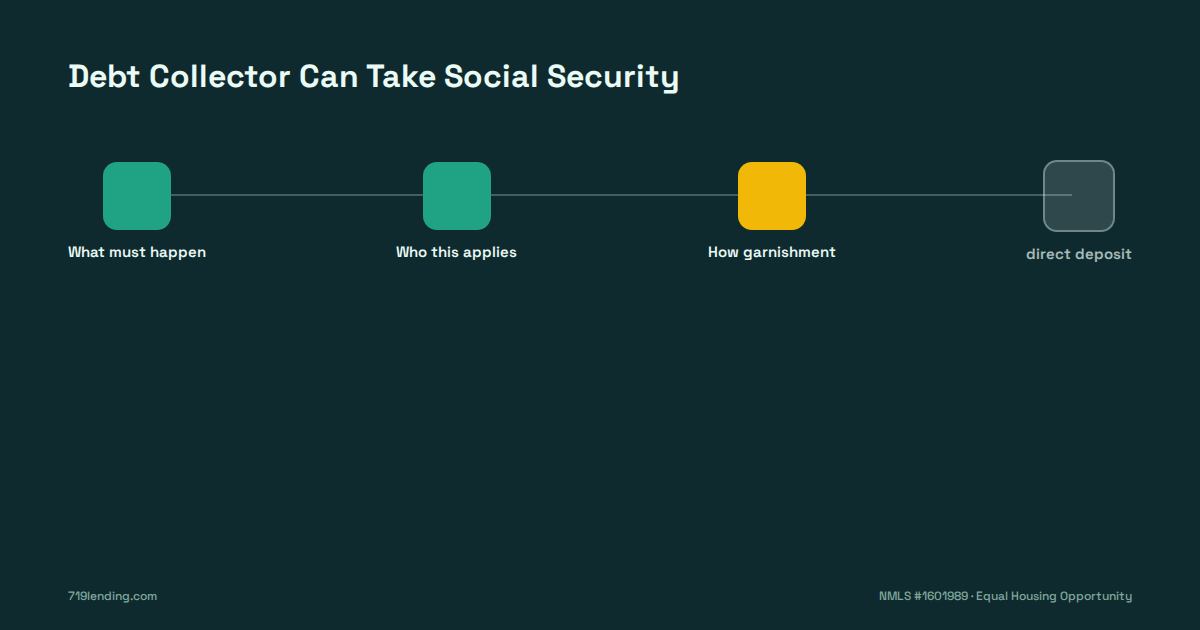
Debt collectors cannot simply take your Social Security or VA benefits. Before any garnishment can happen, a collector must sue you, win a court judgment, and then obtain a court order directed at your bank or credit union. This guide walks through the process, the automatic protections for direct-deposited federal benefits, and what to do if your account is frozen.
Debt Collector Help for Servicemembers: Where to Turn
Wondering where you can get additional help as a servicemember with a debt collector problem? You have more free, official resources than most civilians do, and the Fair Debt Collection Practices Act (FDCPA) gives you enforceable rights when debt collectors contact you.
This guide is for active duty service members, Guard and Reserve members, and military families — including the large active duty community around Colorado Springs installations. It covers your rights, the military-specific wrinkles like chain of command contact and security clearance concerns, and exactly where to go for help.
Where can I get additional help as a servicemember with a debt collector problem?
According to the Consumer Financial Protection Bureau (CFPB), service members dealing with debt collectors have several places to turn:
- Your installation’s legal assistance (JAG) office — free legal information about your rights, with a locator tool to find the nearest office.
- Your local military financial readiness program — a counselor can help you manage your finances and work through the debt.
- Your state attorney general — report any problems with a collector’s conduct.
- The CFPB — submit a complaint online or by calling (855) 411-CFPB (2372); the bureau forwards it to the company and works to get a response.
- Federal court — you can sue a debt collector for FDCPA violations, and if you win, the collector must generally pay your attorney’s fees and may also owe you damages.

Before you pick a resource, it helps to understand what the law already prohibits collectors from doing.
What rights do service members have under the FDCPA?
The Fair Debt Collection Practices Act applies to you the same way it applies to any consumer. Debt collectors can’t harass, abuse, or mislead you — or anyone else they contact about you.
Conduct the law prohibits
The CFPB lists these examples of illegal debt collector conduct:
- Calling you repeatedly with intent to annoy or harass
- Contacting you at an unreasonable time — before 8 a.m. or after 9 p.m., unless you agree
- Using obscene language
- Making false or misleading statements, including about how much you owe
- Publishing your name for not paying a debt (reporting to a credit reporting company is not publishing)
- Threatening to have you arrested for not paying the debt
Those protections apply to everyone. Active duty service members, though, face a few collection situations civilians never do.
How can a debt collector contact my chain of command?
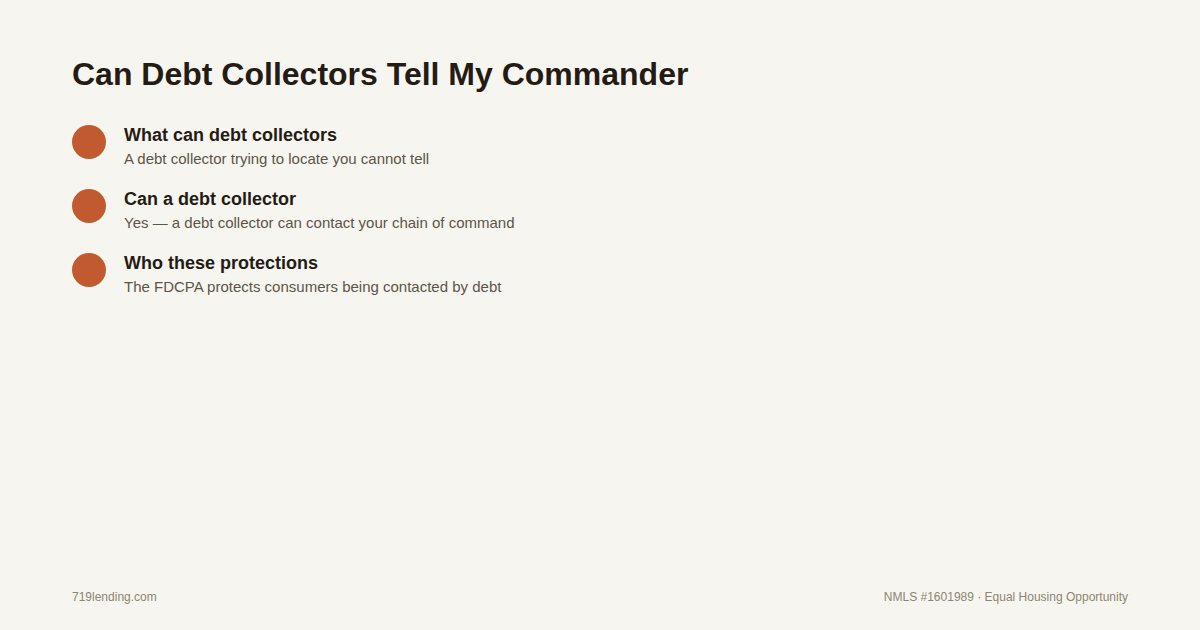
A debt collector can contact your chain of command without your permission, but usually only to find out your location, your phone number, and where you work.
A collector trying to locate you cannot tell your supervisor or commander that you owe a debt. Typically, they can only speak to your supervisor or commander once to get that location information, and they can’t call at all if they already have it.
If a collector crosses that line and discusses the debt itself with your command, that’s a problem worth reporting — which connects directly to the UCMJ question most military members ask next.
Can a debt collector prosecute me under the UCMJ?
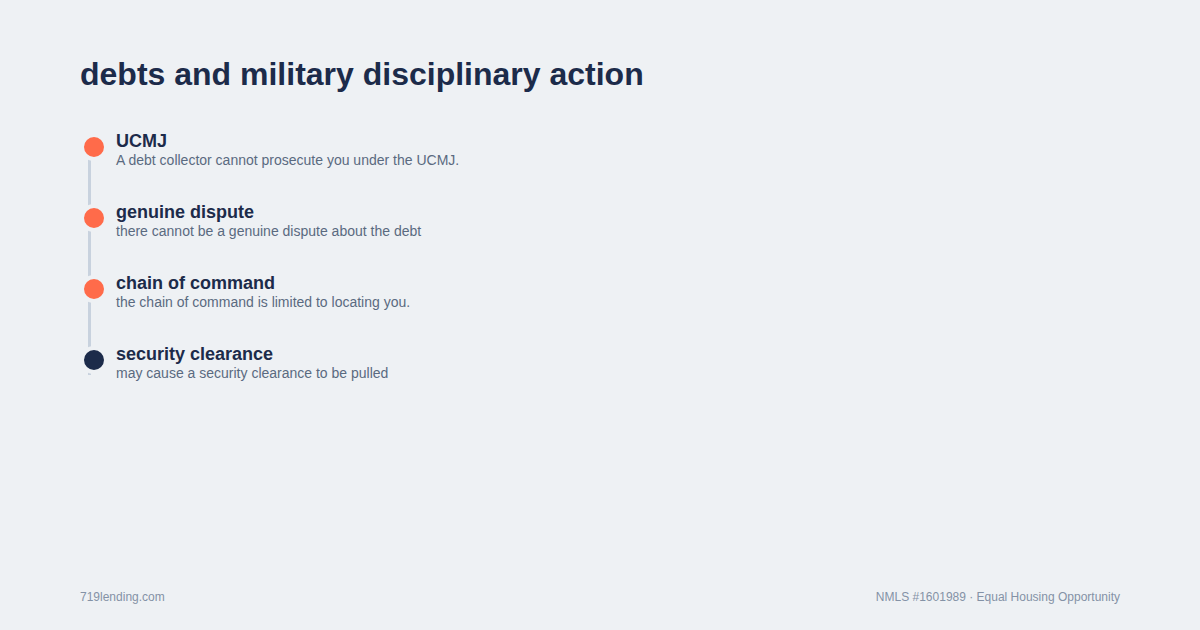
No. A debt collector cannot prosecute you under the Uniform Code of Military Justice — only the military can do that.
That said, servicemembers are expected to pay their legitimate financial obligations in a proper and timely manner. Failure to pay a legitimate obligation may result in disciplinary action under the UCMJ, but only if certain conditions are met.
For example, there cannot be a genuine dispute between you and the debt collector about the debt. If you genuinely dispute what you owe, that dispute matters — and it’s one more reason to get help early rather than ignore collector contact.
Military justice exposure is one concern; your security clearance is another, and it works differently.
Can a debt problem affect my security clearance?
Under the FDCPA, a debt collector is not permitted to share information about your debt with a third party — such as a security manager, supervisor, or commander — without your permission.
The indirect route is the real risk. Failing to pay debts on time can result in negative information landing on your credit report with credit reporting companies, which can lower your credit score and may cause your security clearance to be pulled when it comes up for review.
For active duty service members in clearance-heavy career fields — common around Colorado Springs — resolving legitimate debts in a timely manner protects both your credit rating and your career. The free resources below exist precisely so you don’t have to handle it alone.
Who can help me in person: JAG and financial readiness
Legal assistance (JAG) office
Your closest legal assistance (JAG) office can give you more information about your rights when a debt collector calls. The CFPB points servicemembers to the JAG Legal Assistance Office locator to find the nearest one.
If you’ve been sued or threatened with a lawsuit by a collector, the CFPB specifically recommends consulting your local JAG office.
Military financial readiness program
A counselor at your local military financial readiness program can help you manage your finances, build a plan around the debt, and avoid falling behind on other financial obligations while you deal with the collector.
If you’d rather put something in writing to the collector first, the CFPB has done the drafting for you.
How do I respond to a debt collector in writing?
The CFPB publishes sample letters for servicemembers dealing with debt collectors, covering the most common situations:
- You need more information about the debt
- You do not owe the debt
- You want the debt collector to stop contacting you
- You want the collector to only contact you through your lawyer
- You want to specify how the debt collector can contact you
Picking the right letter depends on whether the debt is actually yours — which is why validation comes before any payment.
What if I actually owe the debt and want to settle?
The CFPB outlines three steps for negotiating a settlement with a debt collector.
Step 1: Confirm you owe the debt
Debt collectors must give you certain information about the debt — generally in writing, by mail or electronically — when they first contact you or within five days of first communicating with you.
That validation information helps you figure out whether you owe the debt and explains how to dispute it if you don’t. If you’re unsure who you owe or how much, request more information before paying anything.
Step 2: Calculate a realistic repayment plan
Review your monthly take-home pay and expenses, and leave room for unexpected expenses and emergencies. Falling behind on other bills while paying this one can create more problems than it solves.
Decide the total you’re willing to pay to settle — one payment or a series of smaller ones — and don’t commit beyond what you can afford. If you have multiple debts with one collector, you can direct which debt a payment applies to, and collectors can’t apply a single payment across debts you’re disputing.
If you’re struggling with budgeting around credit card debt or other balances, a nonprofit credit counselor can help you build a budget and work with the collectors.
Step 3: Make the proposal and get it in writing
Explain your financial situation to the collector. You may have more room to negotiate with a debt collector than you did with the original creditor, and working through a credit counselor or attorney can help.
If you reach a repayment or settlement agreement, get the plan and the collector’s promises in writing before you make any payment — including promises to stop collection efforts and to end or forgive the debt once you complete the plan.
One caution from the CFPB: avoid companies that charge money in advance to settle your debts. Some debt settlement companies promise more than they can deliver, certain creditors may refuse to work with the debt settlement company you choose, and in many cases the company won’t be able to settle the debt anyway.
Settlement works when you owe the debt. A lawsuit is a different situation entirely.
What should I do if a debt collector sues me?
Respond to the lawsuit — personally or through a lawyer — by the date specified in the court papers. Responding doesn’t mean you agree that you owe the debt or that it’s valid; it forces the collector to prove to the court that the debt is valid.
Why ignoring a lawsuit backfires
If you don’t respond, the court can enter a default judgment against you for the amount claimed, plus lawful additional fees for collection costs, interest, and attorney fees as allowed by the judgment. Refusing to accept service is unlikely to be an effective defense.
A judgment gives collectors much stronger tools. Depending on your situation and state law, a creditor with a judgment may be able to garnish your wages, place a lien against your property, or move to freeze funds in your bank account — and you may lose the ability to dispute the debt.
A judgment is a court order, so it’s very difficult to change or set aside once the case is over. You have a much better chance defending the case than waiting until judgment, and you may be able to negotiate a compromise before the court rules.
Getting a lawyer
The CFPB suggests finding an attorney with experience in the Fair Debt Collection Practices Act and debt collection issues. Some attorneys offer free services or reduced fees, and legal aid offices or legal clinics may help for free if you meet their criteria.
Servicemembers should consult their local JAG office or use the JAG Legal Assistance Office locator, or ask the installation’s financial readiness office for information.
Also worth knowing: a collector subject to the FDCPA can’t threaten a lawsuit they don’t intend to file, and can’t sue or threaten to sue once the statute of limitations — the period of time they have to file a lawsuit to collect — has expired.
Where do I report a debt collector?
You have two main reporting channels, and you can use both.
Your state attorney general. Report any problems with a collector’s conduct to your state’s attorney general.
The CFPB. Submit a complaint online or call (855) 411-CFPB (2372). The bureau forwards your complaint to the company and works to get a response.
And remember the private remedy: if you sue under the FDCPA and win, the debt collector must generally pay your attorney’s fees and may also have to pay you damages.
Your next step
Don’t wait for the next debt collector call. If the debt is disputed or you’ve been sued, contact your installation’s legal assistance (JAG) office now. If the debt is legitimate but unmanageable, book time with a military financial readiness counselor and use the CFPB’s sample letters and worksheets to organize your plan.
For service members around Colorado Springs thinking ahead to a home purchase, how you resolve collection items can show up on your credit report — and that’s a conversation worth having early. The team at 719 Lending can walk through what lenders look at on a credit report so you know where you stand before you apply.
Frequently asked questions
Can a debt collector tell my commander that I owe a debt?
No. A collector can contact your chain of command without permission, but usually only to learn your location, phone number, and workplace. A collector trying to locate you cannot tell your supervisor or commander that you owe a debt, and typically may only contact them once for location information.
Can a debt collector have me punished under the UCMJ?
No. Only the military can prosecute under the Uniform Code of Military Justice. However, servicemembers are expected to pay legitimate financial obligations in a proper and timely manner, and failure to pay may lead to disciplinary action if certain conditions are met — for example, there can’t be a genuine dispute about the debt.
Will a debt collection problem affect my security clearance?
A collector can’t share your debt with a security manager, supervisor, or commander without your permission under the FDCPA. But unpaid debts can be reported to credit reporting companies, lower your credit score, and may cause a security clearance to be pulled when it comes up for review.
How do I complain about a debt collector as a servicemember?
Report problems to your state attorney general, and submit a complaint to the CFPB online or by calling (855) 411-CFPB (2372). The CFPB forwards your complaint to the company and works to get a response. You can also sue for FDCPA violations; if you win, the collector generally pays your attorney’s fees and may owe damages.
What happens if I ignore a debt collection lawsuit?
The court can enter a default judgment against you for the amount claimed plus allowed collection costs, interest, and attorney fees. Depending on your state’s laws, a judgment may let the creditor garnish wages, place a lien on property, or freeze bank funds, and you may lose the ability to dispute the debt.
Should I use a debt settlement company?
The CFPB warns against companies that charge money in advance to settle debts. Some promise more than they can deliver, certain creditors may refuse to work with them, and in many cases they can’t settle the debt anyway. A nonprofit credit counselor, an attorney, or your military financial readiness program are alternatives to consider.
719 Lending Inc., NMLS #1601989 · Equal Housing Opportunity
719 Lending Inc. is not affiliated with or endorsed by HUD, FHA, VA, USDA, CHFA, the CFPB, or any government agency.
Last updated: October 2026

Related Posts