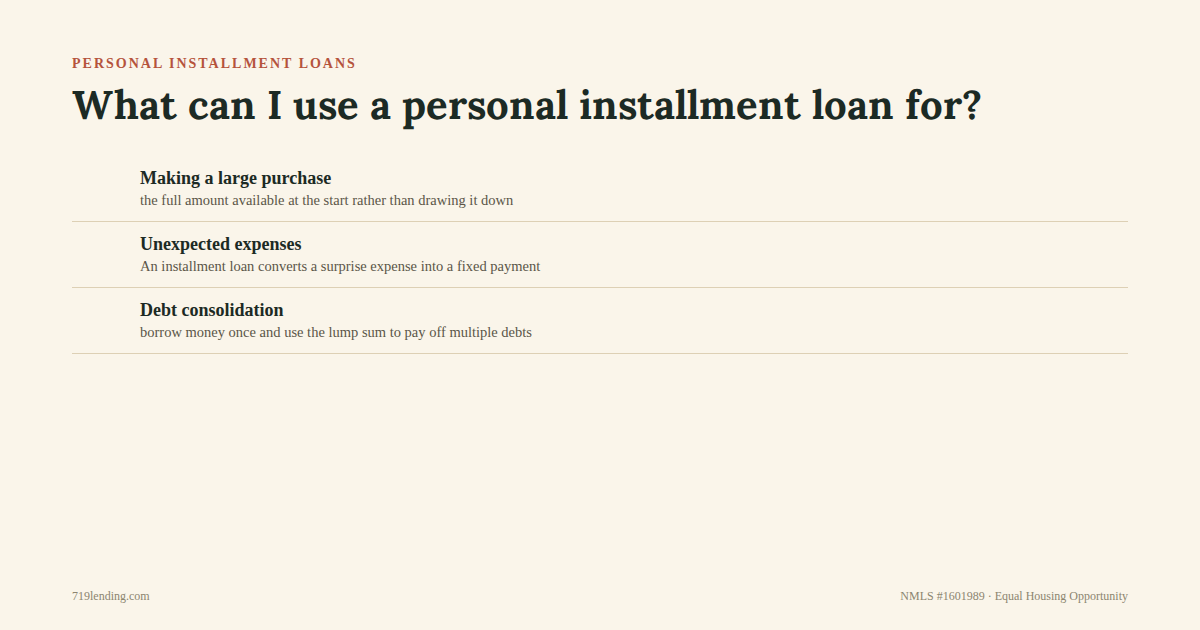
Personal installment loans can be used for a large purchase, an unexpected expense, or consolidating existing debt. This guide walks Colorado borrowers through how installment loans work, what determines the terms, which fees to watch for, and what happens if a payment is missed — all based on official Consumer Financial Protection Bureau guidance.
What Is an Initial Escrow Deposit? A Plain-English Guide
What is an initial escrow deposit? It is the amount you pay at closing to start your escrow account, if your lender requires one, according to the Consumer Financial Protection Bureau. This guide explains how the deposit works, where it shows up in your loan paperwork, and how it differs from both your monthly escrow payment and your earnest money deposit.
It is written for Colorado homebuyers — including the many military families buying around Colorado Springs — who are seeing this line item for the first time on a Loan Estimate.
What is an initial escrow deposit?

An initial escrow deposit is money collected at closing to open and fund your new mortgage escrow account. The escrow account is where your servicer holds funds to pay certain property-related expenses, most commonly property taxes and homeowners insurance.
The deposit gives the escrow account a starting balance so there is money available when the first tax and insurance bills come due. Without that cushion, the account could start empty while large bills are already on the calendar.
One key point from the CFPB: the initial escrow deposit may be different from what you pay monthly to maintain the escrow account. They are two separate things, and we will walk through both.
First, it helps to understand the account the deposit is funding.
How does a mortgage escrow account work?
An escrow account — sometimes called an impound account, depending on where you live — is set up by your mortgage lender to pay certain property-related expenses on your behalf. The CFPB describes it as a way to pay big bills in small pieces.
Where the money comes from
After closing, the money that goes into the escrow account comes from a portion of your monthly mortgage payment. Instead of facing a large annual property tax bill or insurance premium once or twice a year, you send a smaller amount every month through your lender or servicer.
When the tax and insurance bills arrive, the servicer pays them from the escrow balance. You stay current without having to save up for a lump sum on your own.
Who manages the account
Your mortgage servicer manages the escrow account and pays the tax and insurance bills on your behalf. Many lenders require escrow accounts for taxes and insurance so they can make sure those bills get paid, and the CFPB notes that escrow accounts may sometimes be required by law.
Because property taxes and insurance premiums can change from year to year, the escrow payment — and with it, your total monthly payment — will change accordingly.
With the account itself clear, the next question is how the one-time deposit relates to the ongoing monthly amount.
Initial escrow deposit vs. monthly escrow payment
The initial escrow deposit and the monthly escrow payment serve two different jobs, even though both feed the same escrow account.
The initial escrow deposit is a one-time amount paid at closing to give the account a starting balance. The monthly escrow payment is the ongoing escrow portion of each mortgage payment that keeps the account funded as tax and insurance bills come due.
| Initial escrow deposit | Monthly escrow payment | |
|---|---|---|
| When you pay it | Once, at closing | Every month, as part of the mortgage payment |
| Purpose | Opens and seeds the escrow account | Maintains the escrow balance for upcoming bills |
| Where it appears | Section G, page 2 of the Loan Estimate | In the monthly payment breakdown of your disclosures |
| Can it change? | May change between Loan Estimate and Closing Disclosure | Changes when property taxes or insurance premiums change |
The CFPB specifically notes the initial amount may be different from what you pay monthly to maintain the escrow account — so do not be surprised if the two figures on your paperwork do not match.
There is one more deposit homebuyers often confuse with this one: earnest money.
Initial escrow deposit vs. earnest money deposit
Earnest money and the initial escrow deposit both get called “escrow money” in casual conversation, which causes real confusion in a real estate transaction.
Earnest money comes first
Earnest money is the deposit a buyer puts down when an offer on a home is accepted, typically held by a neutral third party — such as a title company acting as escrow agent — until closing. It is part of the purchase negotiation between the buyer and seller, not part of the loan.
The initial escrow deposit comes at closing
The initial escrow deposit, by contrast, happens at closing and funds the mortgage escrow account your servicer will use for property taxes and homeowners insurance after you own the home. Same word, two different stages of the home buying process.
If you are unsure which deposit a document is referring to, ask your loan officer or the escrow agent handling the transaction to point to the exact line item.
Speaking of line items — here is exactly where the official paperwork shows the initial escrow deposit.
Where to find the initial escrow deposit in your loan documents
Federal disclosure rules make this amount easy to locate, and the CFPB spells out exactly where to look.
On the Loan Estimate
The initial escrow deposit is listed in section G on page 2 of your Loan Estimate. That is the standardized disclosure you receive after applying for most home purchase and refinance loans.
On the Closing Disclosure
The amount may change between your Loan Estimate and the time you receive your Closing Disclosure. Compare the two documents side by side, and ask your loan officer to explain any difference before you sign.
Loans that use different disclosures
The CFPB notes you will not receive a Loan Estimate or Closing Disclosure if you are shopping for a reverse mortgage, a home equity line of credit (HELOC), a manufactured housing or mobile home loan not secured by real estate, or a subordinate loan through certain types of homebuyer assistance programs. For those loans, you should receive Truth-in-Lending disclosures instead.
If you are shopping for a reverse mortgage, you will also receive a Good Faith Estimate (GFE) and a HUD-1 or HUD-1A Settlement Statement. There, the initial escrow amount is listed in Block 9 of the GFE and on Line 1001 on page 2 of the HUD-1, or on page 1 of a HUD-1A — and it may change between the GFE and closing.
Knowing where the number lives is half the picture. The other half is why lenders collect it at all.
Why do lenders require escrow accounts?
Many lenders require that you pay your taxes and insurance through escrow so they can make sure those bills get paid. The home is the collateral for the loan, and unpaid property taxes or lapsed homeowners insurance put that collateral at risk.
What happens without an escrow account
If your loan does not include an escrow account, you will have to plan to pay these large expenses yourself. The CFPB cautions that you should budget for these extra costs and stay current on your tax and insurance payments.
If you fail to pay your property taxes, your state or local government may impose fines and penalties or place a tax lien on your home. You could also face foreclosure.
Force-placed insurance and other lender responses
If you fail to pay your taxes or homeowners insurance directly, the CFPB says the lender may add the amounts to your loan balance, add an escrow account to the loan, or purchase new homeowners insurance for you and bill you for it. That lender-purchased coverage, known as force-placed insurance, is typically more expensive than homeowners insurance you pay on your own.
Choosing escrow voluntarily
Even if your lender does not require an escrow account, the CFPB suggests considering one voluntarily. Paying small amounts with each mortgage payment makes it easier to budget for large property-related bills, so you are not scrambling when an annual property tax bill or insurance premium comes due. Whether a lender will let you waive escrow depends on the loan, so confirm the specifics with your loan officer.
For Colorado buyers — especially military families — there are a few local wrinkles worth noting.
Escrow for Colorado Springs and military homebuyers
Colorado Springs is a heavily military market, with buyers regularly arriving on PCS orders and closing on a tight timeline. The initial escrow deposit is one closing cost that sometimes surprises first-time buyers who budgeted only for the down payment.
Because the deposit appears in section G of the Loan Estimate early in the process, you can see it well before closing day and plan your cash to close around it. Review that section as soon as the Loan Estimate arrives.
Property taxes and insurance premiums can change from year to year, which means the escrow portion of the monthly payment — and the total monthly payment — can change too. If your household budgets around BAH, build in room for that movement rather than assuming the first year’s payment is permanent.
And if a future escrow analysis shows the account collected more than the bills required, ask your servicer how any surplus is handled — including whether an escrow refund applies. The servicer managing the account is the right party to confirm its own procedures.
With the mechanics covered, here is how to put this to work.
What to do next
Pull out your Loan Estimate and find section G on page 2. That is your initial escrow deposit, and it is the number to track as you move toward the Closing Disclosure.
Compare the deposit on the Loan Estimate against the Closing Disclosure when it arrives, since the amount may change between the two documents. Ask your loan officer to walk through any difference.
If you want the primary source, read the CFPB’s own answers on the initial escrow deposit and on escrow or impound accounts at consumerfinance.gov. The CFPB notes its content is general consumer information, not legal advice.
Questions about how the escrow account on a specific loan would be set up? Talk with a local loan officer at 719 Lending in Colorado Springs, who can walk through the Loan Estimate line by line before you commit.
Frequently asked questions
What is an initial escrow deposit at closing?
It is the amount you pay at closing to start your mortgage escrow account, if your lender requires one. It gives the account a starting balance so your servicer can pay property taxes and homeowners insurance bills as they come due.
Where is the initial escrow deposit on the Loan Estimate?
The initial escrow deposit is listed in section G on page 2 of your Loan Estimate. The amount may change between the Loan Estimate and your Closing Disclosure, so compare the two documents before closing.
Is the initial escrow deposit the same as earnest money?
No. Earnest money is the deposit a buyer puts down when an offer is accepted, typically held by a neutral third party during the real estate transaction. The initial escrow deposit is paid at closing to fund the escrow account that pays taxes and insurance after you own the home.
Is the initial escrow deposit the same as my monthly escrow payment?
No. The initial deposit is a one-time amount paid at closing to seed the account, while the monthly escrow payment is the ongoing portion of your mortgage payment that keeps the account funded. The CFPB notes the initial amount may differ from the monthly amount.
Why does my lender require an escrow account?
Many lenders require taxes and insurance to be paid through escrow so they can make sure those bills get paid, and escrow accounts are sometimes required by law. If taxes or insurance go unpaid, consequences can include fines, a tax lien, foreclosure risk, or lender-purchased force-placed insurance.
Can my escrow payment change after closing?
Yes. Property taxes and insurance premiums can change from year to year, and your escrow payment — and with it, your total monthly payment — will change accordingly.
719 Lending Inc., NMLS #1601989 · Equal Housing Opportunity
719 Lending Inc. is not affiliated with or endorsed by HUD, FHA, VA, USDA, CHFA, the CFPB, or any government agency.
Last updated: October 2026

Related Posts