Paying off a car before a mortgage can raise your buying power or waste your down payment. See how DTI, credit score, and cash reserves really interact.
How Your Spouse’s Credit Score Affects Your Mortgage
Your spouse’s credit score affects your mortgage mainly through pricing, not approval: when you both go on the loan, conventional lenders qualify and price the file off the lower borrower’s score, so a strong score plus a weak score usually means a higher rate and added fees rather than an automatic denial. That single mechanic drives almost every decision a married couple faces when they buy a home together. Understand it, and you can choose the structure that costs you the least over the life of the loan.
This article walks through exactly how lenders combine two credit profiles, why the lower score wins, when it makes sense to leave a spouse off the application, and how Colorado’s status as a non-community-property state changes the math on a spouse’s debts. Every rule below is drawn from the Fannie Mae Selling Guide, HUD Handbook 4000.1, and the Consumer Financial Protection Bureau, verified against the current published text.

How lenders pick the qualifying credit score for a couple
Each borrower has three credit scores, one from each national bureau. Under the Fannie Mae Selling Guide, the lender first finds each borrower’s individual representative score, then compares borrowers. The rule for a couple is blunt: “If there are multiple borrowers, determine the applicable credit score for each individual borrower and select the lowest applicable score from the group as the representative credit score for the loan.”
So the process runs in two steps:
- Step one, per person. If a borrower has three scores, the lender uses the middle one. If only two scores exist, the lender uses the lower of the two.
- Step two, per loan. The lender compares each borrower’s representative score and keeps the lowest one as the score for the whole mortgage.
That combined score is what the Selling Guide says “is used to determine loan eligibility for manually underwritten loans with only one borrower and for pricing purposes (i.e., assessing LLPAs) on all loans.” In plain terms, the lower spouse’s score sets your interest-rate pricing. The higher spouse’s excellent score does not average up or rescue the file for pricing purposes.
One nuance for couples using manual underwriting: for the narrow question of whether a two-borrower file clears the minimum-score threshold, Fannie Mae looks at the average median of the borrowers’ scores, while still using the lowest representative score for pricing. Most agency loans, though, run through Desktop Underwriter (DU), which does not require a stated minimum score at all; it evaluates the whole risk picture. Either way, the pricing is anchored to the lower score.
Pricing, not denial: what a low spouse score actually costs
Here is the point most couples get wrong. A lower spouse score does not usually stop the loan. It makes it more expensive. Fannie Mae and Freddie Mac apply loan-level price adjustments (LLPAs) — one-time, risk-based fees baked into your rate — and those adjustments are set off the representative credit score, which is the lower borrower’s score. As credit scores fall into lower brackets, the price adjustment climbs; as scores rise, it shrinks or disappears.
Because these fees are usually rolled into the rate rather than paid in cash, the practical effect of a lower spouse score is a higher interest rate for the same loan. The loan still closes. You simply pay more each month. That distinction — cost, not rejection — should frame every conversation a couple has about whose name goes on the note.
Our take: the biggest and most expensive myth we see is a borrower assuming a spouse’s mid-600s score “kills” the approval. On a conventional loan, it almost never does. It raises the price. Once you see it as a price tag instead of a locked door, the real decision — solo versus joint — becomes a math problem you can solve.

The real decision: apply solo or apply together
When one spouse has strong credit and the other has weaker credit, you are weighing two competing forces:
- Pricing. Leaving the weaker-credit spouse off the loan lets you price off the stronger score, which can lower the rate and reduce or eliminate LLPAs.
- Qualifying income and debt-to-income (DTI). Leaving a spouse off also removes that spouse’s income from the calculation. The CFPB defines your debt-to-income ratio as “all your monthly debt payments divided by your gross monthly income” — the yardstick lenders use to “measure your ability to manage the monthly payments.” Drop a spouse’s income and your DTI can rise, shrinking how much house you qualify for.
Fannie Mae caps total DTI at 50% for loans underwritten through Desktop Underwriter; manually underwritten conventional loans generally cap at 36%, stretching to 45% with strong credit and reserves. If removing a spouse’s income pushes your DTI past those ceilings, applying solo may not be an option even if it would price better. So the trade-off is genuinely two-sided, and the right answer depends on your specific numbers.
In our experience, three patterns tend to hold:
- If the stronger-credit spouse earns enough to qualify alone and the weaker spouse’s income is not needed, applying solo usually wins on cost.
- If you need both incomes to hit the loan amount or clear DTI, applying together is often the only path — and the pricing hit is simply the cost of qualifying.
- If the weaker score is close to a bracket boundary, a short credit clean-up before applying can move the whole file into a better pricing tier.
A worked example: solo versus together
Consider a Colorado couple. One spouse has a 760 representative score; the other has a 620. They want a 30-year fixed conventional loan with roughly 20% down.
- Apply together. Both incomes count, which is great for DTI and buying power. But the representative score for the file is the lower 620, so the loan is priced and its LLPAs are set off 620 — a materially higher rate than a 760 file would earn.
- Apply solo (the 760 spouse only). The file prices off 760, typically the best available conventional pricing tier, with little or no credit-driven LLPA. The catch: only the 760 spouse’s income counts toward DTI, which may cap the loan amount.
The difference between a ~620-tier and a ~760-tier rate on a conventional loan is frequently on the order of half a percentage point or more in rate, which on a mid-size mortgage can mean tens of thousands of dollars over 30 years. We are describing the direction and rough scale here, not quoting a specific rate: actual LLPAs and rate spreads change with the published pricing matrix, loan-to-value, and market conditions. Treat any figure as general and confirm current pricing for your file before you decide. The structural point is durable: the lower score governs, and it governs price.
Does your spouse’s debt count against you? Colorado’s answer
A separate worry is whether a spouse’s debts drag down your application even when that spouse is not on the loan. Here, geography matters, and Colorado helps you.
The rule that pulls a non-borrowing spouse’s debts into your ratios is a community-property rule. HUD Handbook 4000.1 requires that for FHA loans, if the borrower resides in a community-property state or the property is in one, the debts of the non-borrowing spouse must be included in the borrower’s qualifying ratios, except for obligations specifically excluded by state law. Only nine states are community-property states: Arizona, California, Idaho, Louisiana, Nevada, New Mexico, Texas, Washington, and Wisconsin.
Colorado is not one of them. Colorado follows equitable-distribution law, not community property. As a result, a non-borrowing spouse’s debts generally are not automatically charged to your debt-to-income ratio on a Colorado FHA or conventional loan the way they would be in a community-property state. A joint debt you both signed for still counts, because it is your obligation too — but your spouse’s solo credit cards or car loan usually do not tank your ratios simply because you are married.
Two caveats worth stating plainly:
- On FHA loans, even in a non-community-property state, the lender will still generally pull a non-borrowing spouse’s credit to identify joint or court-ordered obligations. It is checking for shared debts, not adding the spouse’s separate debts to your ratios.
- If your spouse is on title but not on the loan, both spouses typically must sign certain closing documents so the lender’s lien is enforceable. Being off the loan does not always mean being off the paperwork.
Co-borrower versus co-signer: know which one your spouse is
When a spouse goes on the mortgage, they are usually a co-borrower, not merely a co-signer. The Consumer Financial Protection Bureau describes a co-signer as “a person who agrees to repay a loan along with the primary borrower,” noting co-signers “are equally responsible for and legally obligated to repay the loan.” A co-borrower carries that same full repayment responsibility and typically shares ownership and the benefit of counted income.
The credit consequences flow both ways. Per the CFPB, “any late or missed payments for a co-signed loan will affect both the co-signer and the [borrower’s] credit history.” So a joint mortgage that is paid on time builds both spouses’ credit; one that falls behind damages both. Adding a spouse purely to help — without needing their income — exposes their credit to the loan’s performance while dragging your pricing down to their score. That is often the worst of both worlds. The same logic underpins the caution we give buyers thinking about how co-signing affects buying a house: sign only when the structure actually helps.
Practical moves before you apply
If a spouse’s score is the weak link, you usually have more control than you think in the weeks before applying:
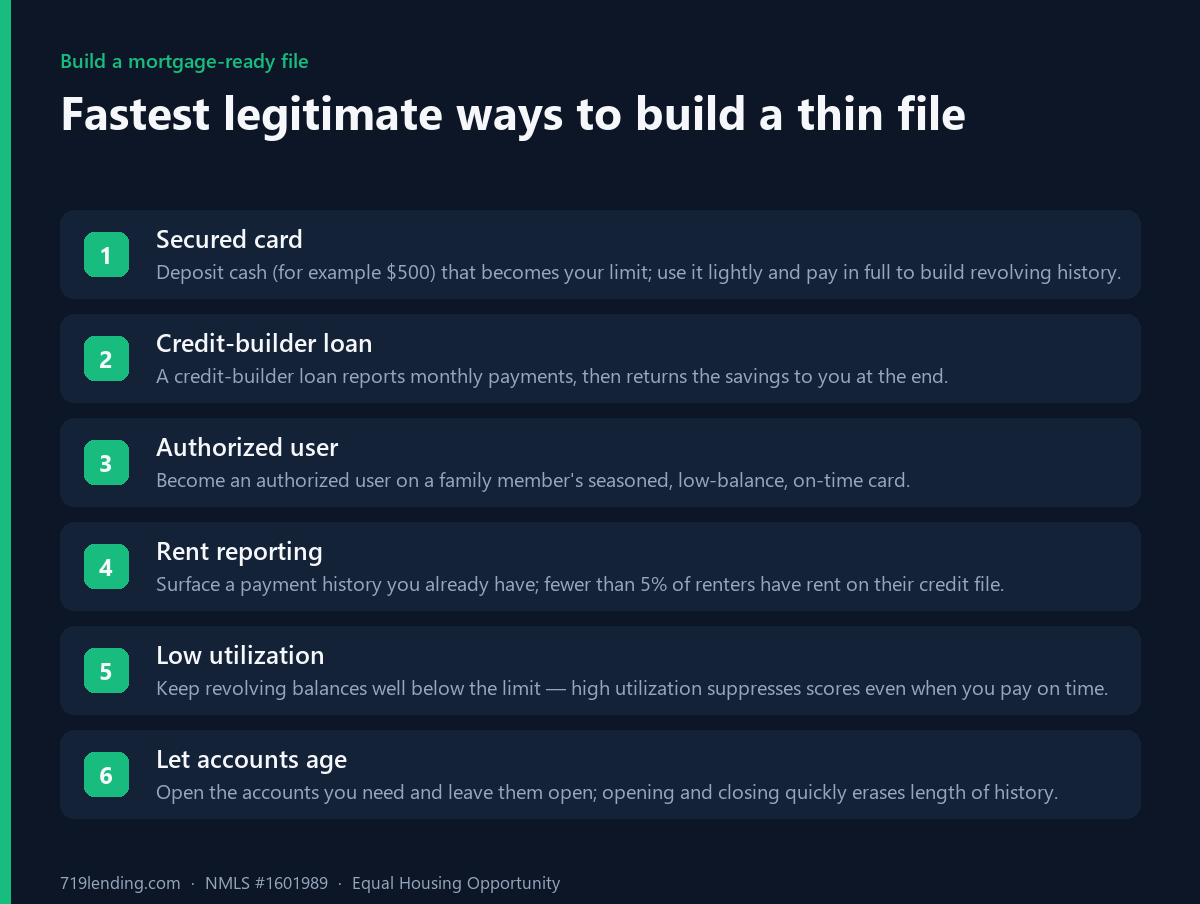
- Attack revolving balances first. Paying down credit-card balances to lower your utilization can lift a score quickly, because balances relative to limits are a heavily weighted factor. Timing this before you apply can move the file into a better pricing tier.
- Do not open new accounts or finance a car. New debt and new inquiries can pull the qualifying score down at the worst moment.
- Fix errors, not just balances. Genuine credit-report errors can be disputed and, once corrected, may raise the representative score that prices your loan.
- Run both structures with your broker. Ask for a side-by-side of solo versus joint — pricing, maximum loan amount, and monthly payment — before you commit. The cheaper structure is not always obvious.
Because a broker can shop your file across multiple wholesale investors, a broker shops your file to find the lender whose pricing grid treats your specific score-and-income combination most favorably. Two lenders can price the same 620/760 couple differently, and that spread is real money.
Frequently asked questions
Does my spouse’s bad credit mean we can’t get a mortgage? Usually no. On conventional loans, a lower spouse score raises your pricing and interest rate rather than triggering an automatic denial, because the file is priced off the lower representative score. You typically still qualify; you just pay more, unless the higher-credit spouse applies alone.
Whose credit score do lenders use when a married couple applies together? The lower one. Fannie Mae has the lender find each borrower’s representative score, then use the lowest of the two as the score for the whole loan, which sets pricing and loan-level price adjustments. The stronger spouse’s score does not average up the file.
Should my spouse be left off the mortgage to get a better rate? Sometimes. Applying with only the higher-credit spouse can improve pricing, but it removes the other spouse’s income, which can raise your debt-to-income ratio and lower how much you qualify for. It is a trade-off between price and buying power that should be run both ways before deciding.
Does my spouse’s debt count against me in Colorado if they’re not on the loan? Generally not automatically. The rule that adds a non-borrowing spouse’s debts to your ratios applies in community-property states, and Colorado is not one of them. Joint debts you both owe still count, but your spouse’s separate debts usually do not simply because you are married.
Will adding my spouse as a co-borrower hurt or help my credit? Both spouses share full responsibility for a joint mortgage, so on-time payments build both credit histories and missed payments damage both. Adding a spouse only helps your file if you need their income; if you do not, you expose their credit and may worsen your pricing.
Can we fix a low spouse score before applying? Often, yes. Paying down credit-card balances to reduce utilization and correcting genuine report errors can raise the qualifying score before you lock. Avoid new debt and new inquiries in the run-up to applying, and ask your broker whether a small delay would move you into a better pricing tier.
719 Lending, NMLS #1601989. Equal Housing Opportunity. 719 Lending is not affiliated with, or acting on behalf of or at the direction of, HUD/FHA, the VA, USDA, or any government agency. This article is educational and not a commitment to lend or financial advice. Rates, credit-score tiers, loan-level price adjustments, and debt-to-income limits are general, change frequently, and vary by loan program, investor, and borrower profile — confirm current figures for your specific scenario. Last updated: June 2026.

Related Posts