Construction loan down payments usually run higher than a standard purchase mortgage, but the land you already own can do a lot of the heavy lifting. Here is how much you actually need by loan type, and how land equity counts toward it.
VA One-Time Close Construction Loan ($0 Down)
Last updated: June 29, 2026 — VA funding-fee percentages and exemption rules are set by the VA and change over time; confirm the current figures with your lender and the VA before relying on them.
VA one-time close construction loan ($0 down)
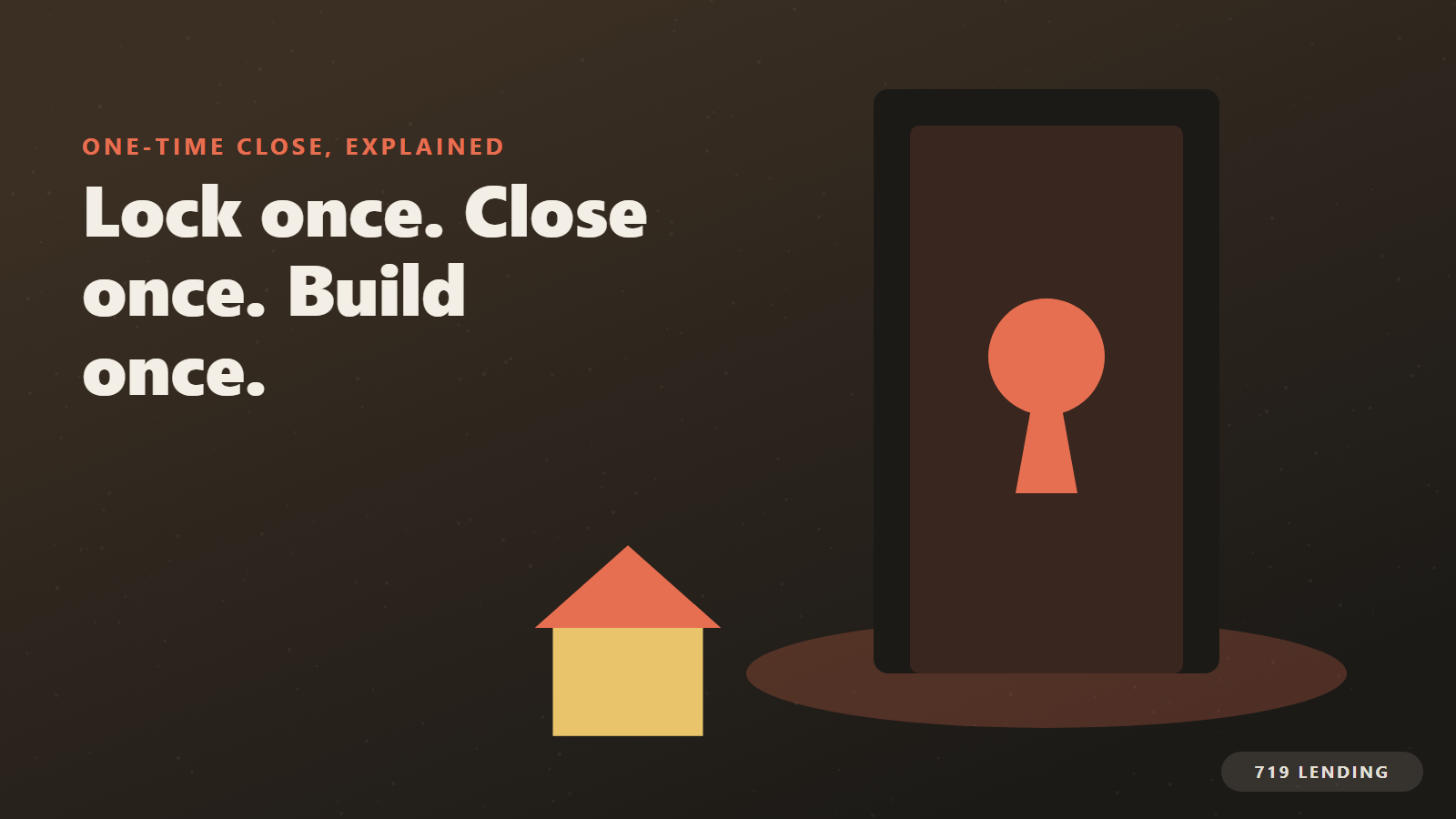
A VA one-time close construction loan lets eligible veterans build a new home with $0 down and a single closing that funds the land, the construction draws, and the permanent mortgage all at once. There’s one set of closing costs, no requalifying when the home is finished, and no monthly mortgage insurance. The builder must be VA-registered, licensed, bonded, and insured.
For service members and veterans around Fort Carson, this is one of the few ways to build from the ground up without a large cash down payment. Below is how the loan actually works in El Paso County, what your builder has to bring to the table, and the real-world tradeoffs to weigh before you start drawing up plans.
What is a VA one-time close construction loan?
It’s a single loan that combines the construction financing and the permanent VA mortgage into one transaction that closes before the build starts. Instead of getting a short-term construction loan and then refinancing into a permanent mortgage (a “two-time close”), you sign once. As the builder hits milestones, the lender releases funds in draws. When the home passes final inspection, the loan converts to a standard VA fixed-rate mortgage.
The “one-time close” structure is the headline benefit: you pay closing costs once, lock your terms up front, and skip a second loan application after construction. That removes the biggest risk of a two-time close, which is getting stuck unable to qualify for the permanent loan after the house is already built.
| Feature | VA one-time close | Two-time close (construction + refi) |
|---|---|---|
| Number of closings | One | Two |
| Sets of closing costs | One | Two |
| Down payment (eligible vets) | $0 | Often required on construction phase |
| Requalify after build | No | Yes |
| Monthly mortgage insurance | None | None on VA permanent loan |
| Rate risk during build | Locked up front | Exposed until refi |
How does $0 down actually work?
VA loans require no down payment for eligible borrowers, and that benefit carries through to the construction version. The loan is sized to the appraised “as-completed” value of the finished home. As long as the total cost to build plus the land stays within that value and your entitlement and income support it, an eligible veteran can finance the entire project with no money down.
What VA does not charge is monthly mortgage insurance — there’s no PMI on any VA loan, which is a meaningful monthly savings versus a low-down conventional construction product. What VA does charge is a one-time funding fee, which can be rolled into the loan balance rather than paid in cash. For a first-use, $0-down VA loan the funding fee is typically a little over 2% of the loan amount, but the exact percentage is set by VA and changes over time, so confirm the current figure with your lender. Veterans receiving VA compensation for a service-connected disability (a rating of 10% or higher) are generally exempt from the funding fee entirely — confirm your current exemption status with your lender and the VA.

What are the builder requirements?
This is where VA construction loans get strict, and it’s the most common reason a build stalls before it starts. The builder — not just the borrower — has to qualify.
- VA-registered builder. The builder must be registered with VA and have a VA Builder ID number, so you generally can’t act as your own general contractor.
- Licensed, bonded, and insured. It’s the lender’s job to verify this. Your builder needs enough demonstrated experience to satisfy both VA and the lender.
- Fixed-price contract. Most lenders require a fixed-price (not cost-plus) construction contract so the budget can’t balloon mid-build.
- One-year builder’s warranty. VA requires the builder to provide a one-year warranty on the completed home.
- Required certifications. Expect builder certification forms (such as HUD/VA builder certification and a wood-destroying-pest certification) plus VA inspections at each draw and at completion.
If you already have a builder in mind in Monument, Falcon, or out toward Peyton, the first question to ask them is simple: “Do you have a VA Builder ID, and have you closed a VA one-time close before?” A builder who’s done it knows the draw and inspection rhythm. A builder who hasn’t can still register, but budget time for it.
Why this matters for building near Fort Carson
El Paso County has one of the highest concentrations of VA-eligible borrowers in Colorado, anchored by Fort Carson, Peterson Space Force Base, and Schriever. At the same time, existing-home inventory in the Colorado Springs area stays tight and competitive, and move-in-ready homes that fit a specific commute to Gate 1 or Gate 20 don’t always exist. Building lets a PCS-ing soldier or a retiring veteran put a new home exactly where they want it — closer to post, on a larger lot in Fountain or Security-Widefield, or in a newer Falcon subdivision — without competing in a multiple-offer bidding war for resale stock.
| Build-near-Fort-Carson factor | Why it matters |
|---|---|
| $0 down | Preserves cash for a PCS move, furniture, and reserves |
| Lock terms up front | Rate certainty across a multi-month build during a deployment or transition |
| No PMI | Lower monthly payment than low-down conventional builds |
| Lot flexibility | Build in Fountain, Falcon, Monument, or Peyton near your commute |

What’s the catch you should plan for?
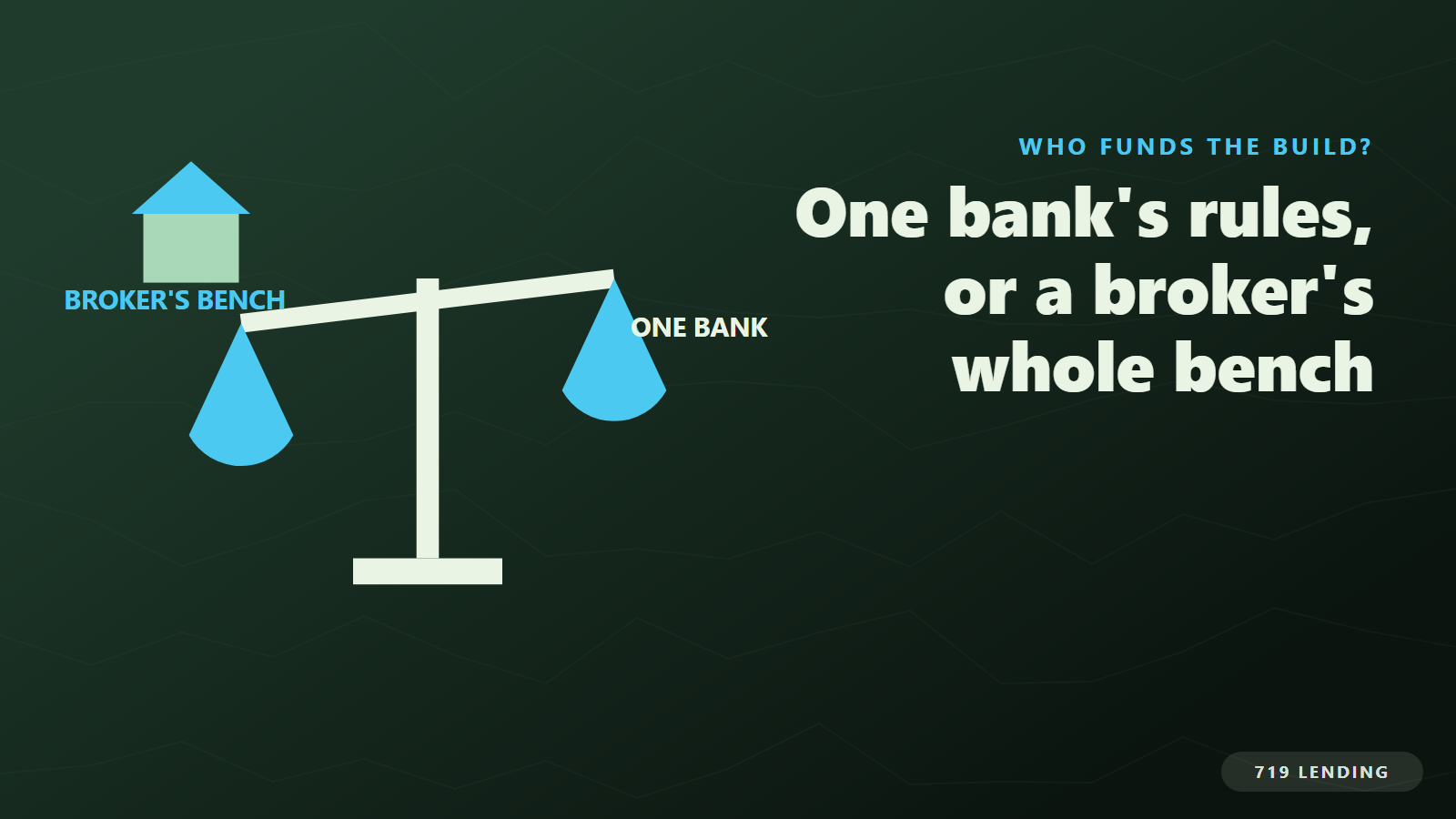
Three things trip people up. First, not every lender offers it. The VA has a single-close construction program, but it’s a specialty product — many big retail lenders don’t do it, which is exactly where a broker who can shop multiple investors helps. Second, your rate is locked before the build. That protects you if rates rise, but you won’t automatically capture a drop; ask your lender about float-down options. Third, timelines are real. Between builder registration, plan approval, appraisal on an as-completed basis, and staged inspections, expect more lead time than a resale purchase. Start the conversation before you fall in love with a lot.
During construction, most lenders structure your payments as interest-only on the funds drawn so far. Once the home is finished and the loan converts, you begin full principal-and-interest payments on the permanent balance — with no new closing costs and no second application.
Related reading
If you’re comparing your options, see our overviews of VA loans in Colorado Springs and the broader construction loan landscape in El Paso County. Not sure a build is right for you? Our first-time buyer guide walks through buying versus building, and our mortgage broker page explains how we shop multiple lenders on your behalf.
Frequently asked questions
Can I use my VA loan to build a house with no money down?
Yes. Eligible veterans can build with $0 down using a VA one-time close construction loan, as long as the total cost to build plus the land stays within the home’s appraised as-completed value and your entitlement and income support the loan. There’s no monthly mortgage insurance, though a one-time VA funding fee applies unless you’re exempt.
Does the builder have to be VA-approved?
The builder must be registered with VA and hold a VA Builder ID number, and must be licensed, bonded, and insured. Most lenders also require a fixed-price contract and a one-year builder’s warranty. You generally cannot act as your own general contractor on a VA construction loan.
What is the VA funding fee on a construction loan?
The funding fee follows the same schedule as a standard VA purchase loan — typically a little over 2% for first use with $0 down — and it can be rolled into the loan balance. VA sets the exact percentage and it can change, so confirm the current figure with your lender. Veterans receiving VA compensation for a service-connected disability (10% or higher) are generally exempt.
What happens to my payments when construction is finished?
During the build, payments are usually interest-only on the amount drawn so far. When the home passes final inspection, the loan converts to a permanent VA fixed-rate mortgage and you begin full principal-and-interest payments — with no requalification and no second set of closing costs.
Why use a broker for a VA construction loan in Colorado Springs?
VA one-time close is a specialty product that many lenders don’t offer. A local broker can shop multiple investors to find one that does, match you with a VA-registered builder near Fort Carson, and coordinate the appraisal, draws, and inspections so the build stays on schedule.
Talk to a local broker who builds VA loans
If you’re a veteran or active-duty service member thinking about building near Fort Carson, 719 Lending can walk you through eligibility, connect the right VA-registered builder, and shop lenders that actually offer the one-time close. Reach out to our Colorado Springs team to see what a build could look like for you.
719 Lending Inc., NMLS #1601989 · Equal Housing Opportunity · This article is educational only, is not a commitment to lend, and not all applicants will qualify. 719 Lending is not affiliated with or endorsed by any government agency.

Related Posts