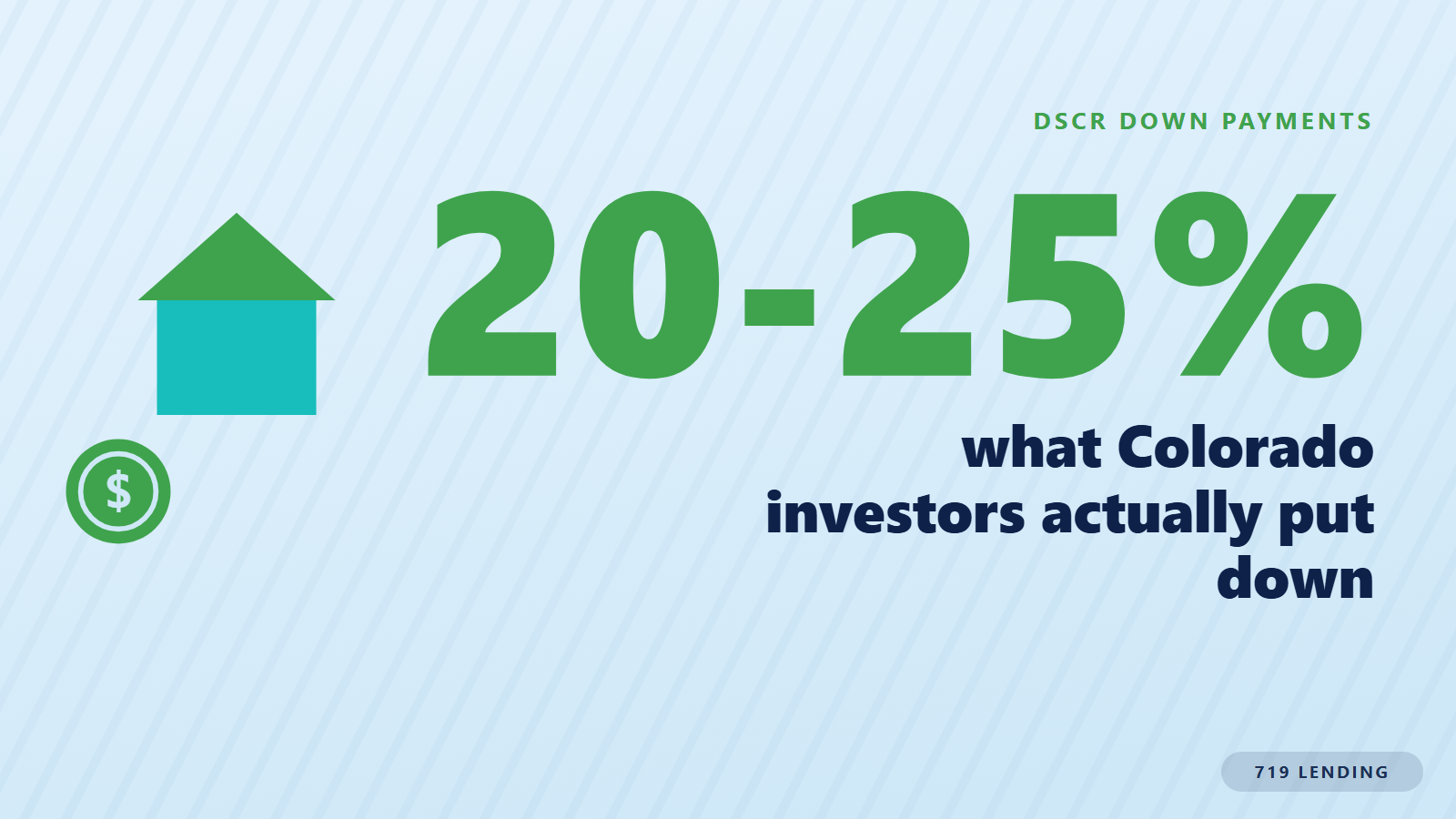
Most DSCR loans in Colorado need 20-25% down, and the exact figure tracks the property's debt-service-coverage ratio. Here's how LTV, reserves, and DSCR math play out for an El Paso County rental.
DSCR Loans in Colorado: The Complete Investor’s Guide
A DSCR (debt-service coverage ratio) loan lets a real estate investor qualify based on the rental income a property generates, rather than on personal W-2s or tax returns. The lender divides the property’s monthly rent by its full monthly payment (principal, interest, taxes, insurance, and any HOA). When rent comfortably covers the payment, you may qualify even if your tax returns understate your income, though credit, reserves, and down payment still apply.
For Colorado investors, that is the whole appeal. Whether you are buying a single-family rental in Pueblo, a duplex near Fort Carson, or a short-term rental on the Front Range, a DSCR loan looks at the deal instead of your day job. This pillar guide walks through the ratio, the typical down payment, credit, and reserve ranges Colorado lenders use, and how the numbers actually play out on local rents. As an independent Colorado Springs mortgage broker, 719 Lending shops multiple non-QM investors to find the structure that fits your deal.
What is a DSCR loan and how does the ratio work?
A DSCR loan is a non-QM (non-qualified mortgage) product designed for investment properties, where approval hinges largely on a single number: the debt-service coverage ratio. The ratio is the property’s gross monthly rent divided by its total monthly housing payment, known as PITIA (principal, interest, taxes, insurance, and association dues).
The formula is simple:
DSCR = Monthly Rent / Monthly PITIA

A DSCR of 1.0 means rent exactly covers the payment, the property breaks even. Above 1.0, the property earns more than it costs to carry. Below 1.0, it falls short and the borrower covers the gap. Most Colorado DSCR lenders look for a ratio of at least 1.0 to 1.25, though several offer programs that allow ratios below 1.0 (sometimes called “no ratio” or sub-1.0 DSCR) at a higher rate or larger down payment. Always confirm current minimums with your broker, because investor guidelines shift with the market.
| DSCR value | What it means | Typical lender view |
|---|---|---|
| 1.25+ | Rent exceeds payment by 25%+ | Strongest pricing tier |
| 1.00 – 1.24 | Rent covers payment with margin | Standard approval range |
| 0.75 – 0.99 | Rent slightly under payment | Often allowed, higher rate or down |
| Below 0.75 / “no ratio” | Rent does not cover payment | Niche programs, largest down payment |
How does a DSCR loan qualify you without personal income?
It qualifies you on the property, not your paycheck. A traditional conventional mortgage runs your personal debt-to-income ratio using W-2s, pay stubs, and two years of tax returns. A DSCR loan skips that step entirely. The underwriter uses a lease or a market-rent appraisal (the Fannie Mae Form 1007 single-family comparable rent schedule) to establish the property’s income, then measures it against the payment.
That makes DSCR loans a strong fit for borrowers whose tax returns understate their real buying power: self-employed investors who write off heavily, people who own several rentals already and have maxed out conventional financing, and full-time investors with no conventional W-2 income. If your tax returns are the obstacle, a DSCR loan or a bank statement loan often solves it. The trade-off is pricing, DSCR rates typically run higher than conventional investment-property rates because the lender takes on a non-QM risk profile.
What down payment, credit, and reserves do Colorado DSCR lenders want?
Plan on a larger down payment, a solid credit score, and several months of reserves. DSCR programs are investor loans, so the guidelines are stricter than an owner-occupied purchase. While every investor sets its own overlays, the ranges below reflect what is common across the Colorado DSCR market. Treat these as typical, not promised, your actual terms depend on the property, the ratio, and the lender you are matched with.
| Requirement | Typical Colorado range | Notes |
|---|---|---|
| Down payment | 20% – 25% | Lower DSCR or credit usually pushes this higher |
| Minimum credit score | 620 – 680+ | Higher scores unlock better rate tiers |
| Cash reserves | 3 – 6 months PITIA | More properties owned can mean more reserves |
| Minimum DSCR | 1.0 (some allow below) | Confirm current minimums per lender |
| Loan purpose | Purchase, rate/term, cash-out refi | Cash-out common to recycle capital |
| Property types | 1–4 units, condos, some STRs | Short-term rental rules vary by lender |
One Colorado-specific note: many DSCR lenders treat short-term rentals (Airbnb, VRBO) differently than long-term leases, sometimes requiring a 12-month rental history or a market-rent analysis based on long-term comps instead of nightly projections. If your strategy is a mountain-adjacent STR, ask up front how the lender will count the income.
How does the DSCR math work on a real Colorado rental?
Here is a realistic Colorado Springs example. El Paso County’s market gives investors a workable spread between purchase prices and rents, especially compared with Denver. Say you buy a single-family rental for $400,000 with 25% down ($100,000), financing $300,000.
| Line item | Monthly amount |
|---|---|
| Principal & interest (est.) | $2,050 |
| Property taxes (est.) | $240 |
| Insurance (est.) | $130 |
| HOA | $0 |
| Total PITIA | $2,420 |
| Market rent (est.) | $2,600 |
| DSCR | 1.07 |
At a 1.07 ratio, the rent covers the payment with a small cushion, which lands in the standard approval band for most Colorado DSCR lenders. Push the rent toward $3,000 (a larger home or a duplex), or trim the loan with more down, and the ratio climbs into the stronger pricing tier. The figures above are illustrative, not a rate quote, taxes, insurance, and rents vary by neighborhood and property. Areas like Pueblo, where purchase prices run lower, can sometimes produce stronger ratios even though rents are also lower, because the payment drops faster than the rent. This is exactly the kind of deal-level math a local broker can run with you before you write an offer.

When does a DSCR loan beat a conventional investment loan?
A DSCR loan tends to win when your tax returns, your number of financed properties, or your speed needs make conventional financing painful. Conventional investment loans usually offer lower rates, so if you have clean W-2 income and few existing rentals, conventional may be cheaper. DSCR often pulls ahead in these cases:
- You are self-employed and write off aggressively — your taxable income is low even though cash flow is strong.
- You already have several financed properties — conventional financing generally caps at ten financed properties per borrower (Fannie Mae), while DSCR programs typically have no such limit.
- You want to scale quickly — DSCR underwriting is property-focused and often faster, with no employment verification to chase.
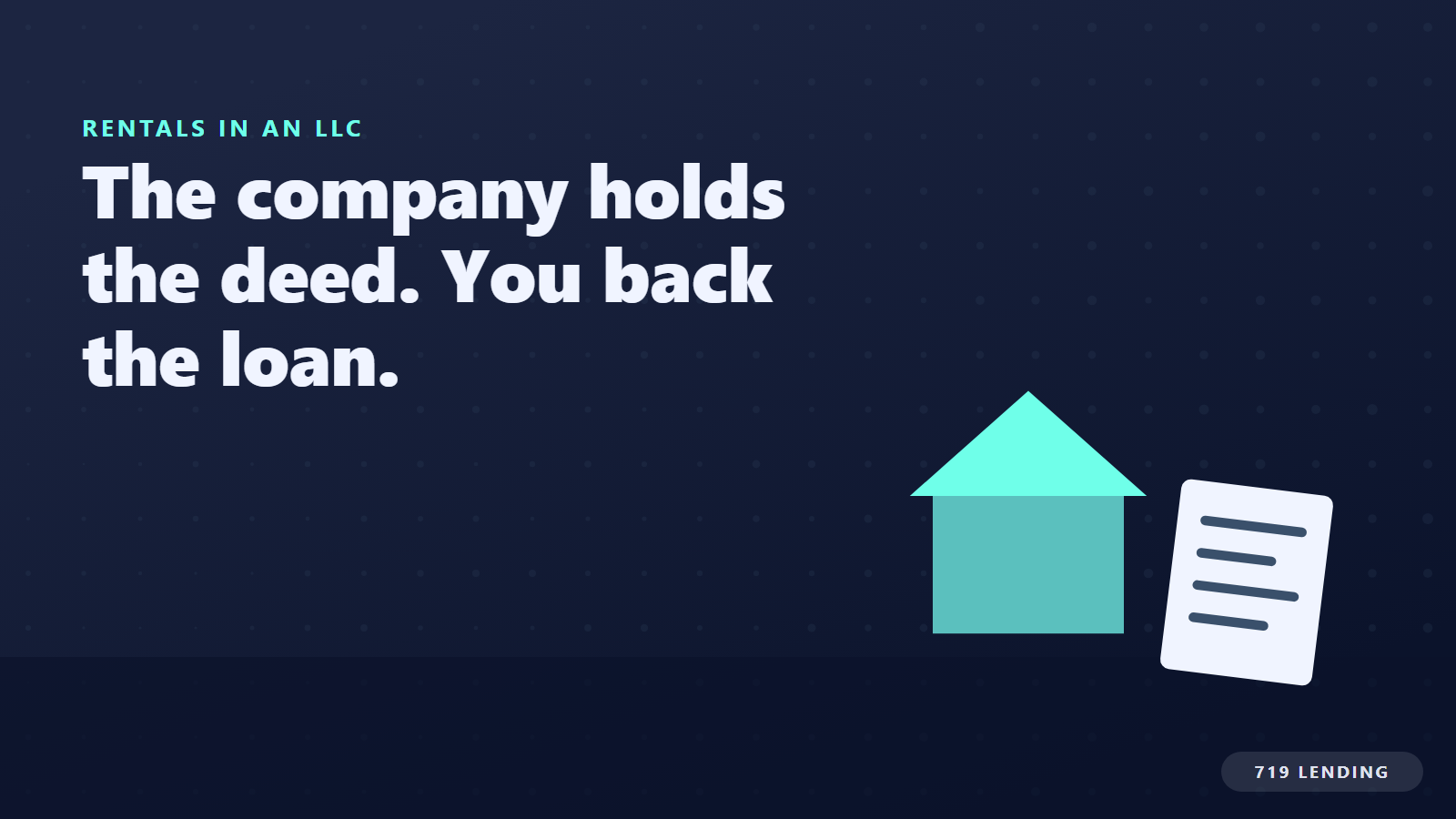
- You hold properties in an LLC — many DSCR lenders close in the name of an LLC, which conventional investment loans generally will not do.
If none of those apply, it is worth comparing a conventional path or a bank statement loan side by side. A broker can model both and show you the real cost difference over your expected hold.
Frequently asked questions
What is the minimum DSCR ratio to qualify in Colorado?
Most Colorado DSCR lenders look for a ratio of at least 1.0, meaning rent covers the full payment. Many programs allow ratios below 1.0 (and some “no ratio” options ignore it entirely) in exchange for a larger down payment or higher rate. Confirm current minimums with your broker, since they shift with market conditions.
Can I get a DSCR loan with no income documentation?
Generally yes, that is the core feature. DSCR loans typically do not require pay stubs, W-2s, or tax returns. The lender qualifies the loan on the property’s rent versus its payment, using a lease or a market-rent appraisal. You will still document credit, reserves, and the down payment.
Can I close a DSCR loan in an LLC?
Often, yes. Many DSCR lenders allow closing in the name of an LLC, which is a common reason investors choose this product over conventional financing. Guidelines vary, so confirm the lender’s entity rules and any personal-guarantee requirements before you set up the structure.
Do DSCR loans work for short-term rentals in Colorado?
Some do, but rules vary. Certain lenders count nightly-rate projections, while others require a 12-month rental history or use long-term market-rent comps instead. If you are buying a short-term rental near the mountains or in a tourist corridor, ask how the lender will calculate the income before you commit.
Are DSCR rates higher than conventional investment rates?
Generally yes. Because DSCR loans are non-QM and skip personal income verification, rates typically run above conventional investment-property rates. The premium is often worth it for investors who cannot qualify conventionally or who value the speed and LLC flexibility. Compare both before deciding.
Talk to a Colorado broker who runs the numbers first
Every DSCR deal lives or dies on the ratio, and the ratio depends on rent, taxes, insurance, and how the lender counts your property. 719 Lending shops multiple non-QM investors to match your deal to the right program, then runs the math with you before you write an offer. If you are weighing a DSCR loan on a Colorado Springs, Pueblo, or Front Range rental, reach out to 719 Lending and we will pressure-test the deal together.
719 Lending Inc., NMLS #1601989 · Equal Housing Opportunity · This article is educational only, is not a commitment to lend, and not all applicants will qualify.

Related Posts